|
 |
 |
 |
 |
 |
 |
 |
 |
 |

| . |  |
. |
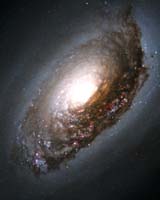
An Abrasive Collision Gives One Galaxy A "Black Eye"
Baltimore - Feb 09, 2004 A collision of two galaxies has left a merged star system with an unusual appearance as well as bizarre internal motions. Messier 64 (M64) has a spectacular dark band of absorbing dust in front of the galaxy's bright nucleus, giving rise to its nicknames of the "Black Eye" or "Evil Eye" galaxy. Fine details of the dark band are revealed in this image of the central portion of M64 obtained with the Hubble Space Telescope. M64 is well known among amateur astronomers because of its appearance in small telescopes. It was first cataloged in the 18th century by the French astronomer Messier. Located in the northern constellation Coma Berenices, M64 resides roughly 17 million light-years from Earth. At first glance, M64 appears to be a fairly normal pinwheel-shaped spiral galaxy. As in the majority of galaxies, all of the stars in M64 are rotating in the same direction, clockwise as seen in the Hubble image. However, detailed studies in the 1990's led to the remarkable discovery that the interstellar gas in the outer regions of M64 rotates in the opposite direction from the gas and stars in the inner regions. Active formation of new stars is occurring in the shear region where the oppositely rotating gases collide, are compressed, and contract. Particularly noticeable in the image are hot, blue young stars that have just formed, along with pink clouds of glowing hydrogen gas that fluoresce when exposed to ultraviolet light from newly formed stars. Astronomers believe that the oppositely rotating gas arose when M64 absorbed a satellite galaxy that collided with it, perhaps more than one billion years ago. This small galaxy has now been almost completely destroyed, but signs of the collision persist in the backward motion of gas at the outer edge of M64. Related Links The Space Telescope Science Institute SpaceDaily Search SpaceDaily Subscribe To SpaceDaily Express  SwRI Goes Suborbital In Search Of The Goods On Mercury And "Vulcanoids"
 Boulder - Jan 27, 2004
A new major scientific payload flew in space last week after launching aboard a NASA suborbital Black Brant rocket. The payload, consisting of a telescope/spectrometer combination and an image-intensified imaging system, successfully explored the ultraviolet spectrum of the planet Mercury and also searched for the long-sought belt of small bodies called Vulcanoids that may lie even closer to the Sun than Mercury. Southwest Research Institute (SwRI) provided the payload and is responsible for data analysis. |
|
|

| The content herein, unless otherwise known to be public domain, are Copyright 1995-2006 - SpaceDaily.AFP and UPI Wire Stories are copyright Agence France-Presse and United Press International. ESA PortalReports are copyright European Space Agency. All NASA sourced material is public domain. Additionalcopyrights may apply in whole or part to other bona fide parties. Advertising does not imply endorsement,agreement or approval of any opinions, statements or information provided by SpaceDaily on any Web page published or hosted by SpaceDaily. Privacy Statement |