|
 |
 |
 |
 |
 |
 |
 |
 |
 |

| . |  |
. |
An Odyssey Of Martian Science
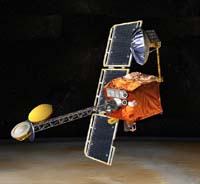
Pasadena - Oct 23, 2001 The Mars Odyssey 2001 space probe has successfully being inserted into orbit about Mars following a 20 minute engine burn. Confirmation of the successful orbital insertion came at 7.56pm Pacific Time Tuesday evening when Odyssey's time delayed signal was reacquired by NASA's Deep Space Network. This is the first time a probe has approached Mars since the failure of the Mars Climate Orbiter and Mars Polar Lander probes in 1999. It arrives after a 200-day, 460 million kilometer (286 million mile) voyage and will spend the two-and-a-half years helping planetary scientists study the geology and chemical composition of the red planet. On Tuesday, at 7:26pm Pacific time (0226 GMT Wednesday), the Mars Odyssey fired its main engine for 20 minutes to slow down for the delicate operation of entering the red planet's orbit, according to officials at NASA's Jet Propulsion Laboratory (JPL) in Pasadena, California. "The flight team uplinked the sequence of commands that control the orbit insertion on October 15. Now we will closely monitor the spacecraft's progress as it approaches Mars and executes the orbit insertion burn," said Odyssey project manager Matthew Landano. Before going into orbit, the probe's fuel tanks -- the size of two volleyballs -- were pressurized and the hydraulic pipes warmed. Firing the main engine for 20 minutes burnt 262.9 kilograms (580 pounds) of fuel. The probe's initial orbit, in an oval shape, will last for 19 hours, gradually becoming smaller until the probe touches the atmosphere of the red planet, in a difficult process known as aerobraking. Eventually, Mars Odyssey 2001 will settle into a two-hour circular orbit at an altitude of about 400 kilometers (250 miles). The 725-kilogram (1,600-pound) probe, which was launched April 7 from the Kennedy Space Center in Cape Canaveral, Florida, will then be able to begin its mission. The probe is carrying a gamma ray spectrometer, which includes a high-energy neutron detector, as well as a thermal-emission imaging system and a Martian radiation environment experiment. These highly sophisticated measuring instruments will enable scientists to gather data on the possible presence of water in the Martian crust, at up to one meter (yard) below the surface. The mission should also enable scientists to better understand the geology of the Martian surface and the nature of radiation that strikes the planet and could be dangerous to humans. The 300-million-dollar (337-million-euro) mission is considered a resumption of Mars exploration by NASA, and is the first new program launched since the failure of the two 1999 probes, which crashed into the planet's surface through human errors due to a lack of training. Related Links Odyssey 2001 Mission Home SpaceDaily Search SpaceDaily Subscribe To SpaceDaily Express  Odyssey Mars Probe Lost
 Pasadena - Oct 23, 2001
For the third time in two years NASA appears to have lost a spacecraft about Mars. The Mars Odyssey 2001 space probe was to have fired its main engine for 20 minutes at 7.26pm Pacific Time, with confirmation of a successful orbital insertion expected shortly after 7.56pm Pacific Time evening when Odyssey's time delayed signal was to have been reacquired by NASA's Deep Space Network at Goldstone. |
|
|

| The content herein, unless otherwise known to be public domain, are Copyright 1995-2006 - SpaceDaily.AFP and UPI Wire Stories are copyright Agence France-Presse and United Press International. ESA PortalReports are copyright European Space Agency. All NASA sourced material is public domain. Additionalcopyrights may apply in whole or part to other bona fide parties. Advertising does not imply endorsement,agreement or approval of any opinions, statements or information provided by SpaceDaily on any Web page published or hosted by SpaceDaily. Privacy Statement |