|
 |
 |
 |
 |
 |
 |
 |
 |
 |

| . |  |
. |
An Oxygen Factory In A Nearby Galaxy
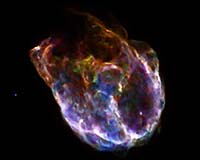
Boston MA (SPX) Mar 18, 2008 This Chandra X-ray Observatory image shows the debris of a massive star explosion in the Large Magellanic Cloud, a small galaxy about 160,000 light years from Earth. The supernova remnant (SNR) shown here, N132D, is the brightest in the Magellanic clouds, and belongs to a rare class of oxygen-rich remnants. Most of the oxygen that we breathe on Earth is thought to have come from explosions similar to this one. The colors in this image show low energy X-rays (red), intermediate energy X-rays (green) and high energy X-rays (blue). Substantial amounts of oxygen are detected in this image, particularly in the green regions near the center of the image. The location of these oxygen-rich areas, detected in the Chandra image, is generally well matched with the oxygen-rich areas detected in Hubble Space Telescope images (not shown here). However, the expanding, ellipse-shaped shell of oxygen seen in N132D is not seen in either G292.0+1.8 or Puppis A, two oxygen-rich SNRs in the galaxy with similar ages to N132D (about 3,000 years, ten times older than Cas A). The origin of this shell is unknown, but it might have been created by a `nickel bubble' shortly after the supernova explosion, caused by radioactive energy input from nickel that was created by the explosion. The existence of such bubbles is predicted by theoretical work. The ultimate goal of these observations is to constrain the mass of the star that exploded and to learn more about how massive stars explode and spread heavy elements like oxygen into surrounding space. Community Email This Article Comment On This Article Related Links Stellar Chemistry, The Universe And All Within It
 Europe Astrophysicists Study How Stars Evolve And Elements Are Formed In Cosmos
 Athens, Greece (SPX) Mar 13, 2008
One of the great ongoing challenges of astrophysics, to find out how stars evolve and die, is to be tackled in an ambitious European research programme. This will involve studying in the laboratory over 25 critical nuclear reactions using low-energy stable beams of ions, in order to understand stellar evolution. |
|
|

| The content herein, unless otherwise known to be public domain, are Copyright 1995-2007 - SpaceDaily.AFP and UPI Wire Stories are copyright Agence France-Presse and United Press International. ESA Portal Reports are copyright European Space Agency. All NASA sourced material is public domain. Additional copyrights may apply in whole or part to other bona fide parties. Advertising does not imply endorsement,agreement or approval of any opinions, statements or information provided by SpaceDaily on any Web page published or hosted by SpaceDaily. Privacy Statement |