 |
 |
 |
 |
 |
 |
 |
 |

| . |  |
. |

|
|
. |

 by Staff Writers Bonn, Germany (SPX) Aug 31, 2011
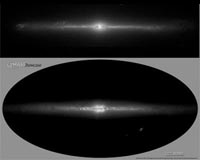
It may not be much use to hitchhikers through the galaxy, but it is extremely valuable to astronomers: the new radio atlas of the Milky Way. After almost ten years of work, researchers at the Max Planck Society and the Chinese Academy of Sciences have completed their investigation into the polarised radio emission in the galactic plane. The atlas is based on observations undertaken with the 25-metre radio telescope in the Chinese city of Urumqi and shows an area of 2,200 square degrees of the sky. The radio survey covers the northern band of the Milky Way between ten and 230 degrees galactic longitude and between minus five and plus five degrees galactic latitude. The comprehensive survey shows the polarised radio emission of our galaxy at five gigahertz (corresponding to a wavelength of six centimetres) and thus at the highest frequency every recorded by terrestrial instruments. The interstellar medium of the Milky Way comprises magnetic fields, electrons, atomic gas and other components which affect the polarisation plane of the radio emission. The Partner Group of the Max Planck Institute for Radio Astronomy, which was set up at the National Astronomical Observatory (NAO) in Beijing, investigated the properties of regions of large-scale diffuse emission and mapped the structure of large objects which cannot be observed by larger radio telescopes. These include densely ionised clouds - the HII regions - and the remnants of exploded stars. The aim of the project was to map the large-scale magnetic field of the Milky Way. The German and Chinese researchers found a handful of peculiar clumps with very strong, regular magnetic fields (Faraday screens) and two new supernova remnants each measuring around one degree. These are the first sources of this type to be discovered with a Chinese radio telescope; astronomers are currently only aware of 270 such objects in the Milky Way. The researchers were also able to classify two incorrectly identified supernova remnants as thermal radio sources. The new atlas needed more than 4,500 hours of observations to compile, and its angular resolution is similar to that of the 21-cm wavelength survey of the Milky Way obtained at the 100-metre radio telescope at Effelsberg. The comparative analysis of these two large-scale sky surveys at similar angular resolution leads to a better understanding of the processes occurring in the interstellar medium. The establishment of the Partner Group in China dates back to a resolution of the Max Planck Society on November 9, 2000. The proposal involved collaboration in the exploration of magnetic fields in galaxies with special emphasis being placed on the investigation of the magnetic field of our Milky Way. The most important contribution made by the Max Planck Institute for Radio Astronomy in Bonn relates to the construction of a receiver for radio emission at six-centimetre wavelength including polarisation, which is being used at the 25-metre Nanshan radio telescope in Urumqi. The advantage of this radio telescope is its location at an altitude of 2,000 metres, where the better weather conditions are advantageous when observing radio emission at higher frequencies. "Reciprocal visits to the institutes involved have formed a whole series of personal contacts," says Richard Wielebinski, emeritus Director at the Max Planck Institute for Radio Astronomy. "As far as the German researchers are concerned, we have established a good collaboration with our Chinese colleagues. Things which began with the Partner Group will be continued on a personal level." "In the course of our work on this project, a total of five doctorates have been completed in our research group," says Jin-Lin Han, the Head of the Partner Group in Beijing. "Our collaboration has significantly boosted the development of radio astronomy in China. The way the objective of the Partner Group has been achieved is excellent."
|
. |
|
| The content herein, unless otherwise known to be public domain, are Copyright 1995-2011 - Space Media Network. AFP and UPI Wire Stories are copyright Agence France-Presse and United Press International. ESA Portal Reports are copyright European Space Agency. All NASA sourced material is public domain. Additional copyrights may apply in whole or part to other bona fide parties. Advertising does not imply endorsement,agreement or approval of any opinions, statements or information provided by Space Media Network on any Web page published or hosted by Space Media Network. Privacy Statement |
 del.icio.us
 Digg
Digg Reddit
 Google