
 |
 |
 |
 |
 |
 |
 |
 |
 |
 |

| . |  |
. |
Analysis: German-Kosovar terror scandal
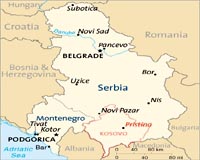
Berlin (UPI) Nov 25, 2008 Three men alleged to be German spies are accused of having bombed a building in Kosovo that houses the European Union's special representative, an affair that threatens to severely strain German-Kosovar ties. The past few days have been ripe with speculation, a significant amount of accusations and flashy headlines in Germany and Kosovo. The question observers are asking themselves is this: Did German spies really bomb an EU building? Three Germans were arrested last weekend in Pristina, the capital, in connection with a Nov. 14 bombing of the International Civilian Office, a building that sits on a hill overlooking the city and houses the EU's representative. No one was injured in the blast, but it nevertheless sent shock waves throughout Germany, where the Sueddeutsche Zeitung newspaper identified the trio as former German soldiers now working for the Federal Intelligence Service, or BND, the major German spy service. The men, identified by the German press only as Robert C., 47, Andreas B., 41, and Andreas J., 41, have been placed in investigative custody and are being treated as terrorist suspects. German government spokesman Thomas Steg earlier this week called the charge that Germany may be involved in the bombing "absurd" but did not want to comment on whether the men are indeed spies. The Kosovar government's main evidence is a video that allegedly shows Andreas J. throwing a bomb into the ICO from a neighboring building, the Sueddeutsche Zeitung newspaper writes, citing a Kosovar government official. A German security official, however, told the newspaper that the video did not feature one of the suspects, but only a bomb flying into the compound. Observers are asking themselves why German spies would bomb the ICO. Looking at Germany's involvement in Kosovo, it wouldn't make too much sense. Berlin was among the first governments to recognize Kosovo, and it dishes out a significant amount of aid to stabilize the Balkan country. Germany contributes some 2,600 soldiers to the NATO force in the country and will also deploy experts to help man EULEX, the 2,000-strong police and judicial mission the EU has been preparing for months. There hardly is a country in Europe that has been doing more in the Balkans. So what is this scandal all about? German newsmagazine Der Spiegel reported that Andreas J. was at the scene of the crime roughly four hours after the blast; he and his two colleagues have been gathering information over the past weeks for EULEX, which Pristina sees as undermining its sovereignty. Four days before the bombing, the Kosovar government rejected a U.N. plan for the EU mission, arguing that it would partition the country into an Albanian half and a Serbian half. The plan foresees the Serb-run areas in Kosovo's north as being under U.N. control, with only the remaining, Albanian-dominated regions under the EU umbrella. Pristina on Tuesday rejected another U.N. proposal and is extremely unhappy that Serbian pressure resulted in the EU mission taking effect only in the Albanian part of the country. Another source of the conflict may be the BND itself. The German spy service has been very active in Kosovo, and this may be one reason for the entire affair. The BND in the past has linked senior Kosovar government figures with organized crime. In a 2005 report the BND accused rebel leader Hashim Thaci, who today is Kosovo's prime minister, of being involved with local organized crime. Thaci denied these allegations in an interview with the Sueddeutsche Zeitung newspaper, but German security officials nevertheless see them as a reason for Kosovo to get back at the BND. After all, the three Germans were arrested with much fanfare -- with photographers on the scene -- as if to embarrass them or their spy service. The newspaper also claims Pristina initially agreed to extradite the men to Germany, but authorities in a last-minute move revoked the landing permission for a jet Germany had sent to Kosovo. If the men were to be found responsible for the blast, however, it would spell serious trouble for Germany's BND. Founded in 1956, the service in the past has come under fire for dubious interrogations in secret prisons in Afghanistan and Syria, and in the U.S. military detention center at Guantanamo Bay, Cuba. It also surfaced that the BND spied on journalists in Germany and, recently, on an Afghan government minister. With the latest affair threatening to bring about an international crisis, even critics of the BND hope the allegations against the German trio won't prove to be true. Share This Article With Planet Earth
Related Links The Long War - Doctrine and Application
 Raytheon Awarded Contract For Exploratory Research In Nuclear Detection
 Tewksbury MA (SPX) Nov 25, 2008
Raytheon was awarded a Department of Homeland Security contract to develop a Stand-Off Warning Against Radiological Materials (SWARM) technology. |
|
|

| The content herein, unless otherwise known to be public domain, are Copyright 1995-2007 - SpaceDaily.AFP and UPI Wire Stories are copyright Agence France-Presse and United Press International. ESA Portal Reports are copyright European Space Agency. All NASA sourced material is public domain. Additional copyrights may apply in whole or part to other bona fide parties. Advertising does not imply endorsement,agreement or approval of any opinions, statements or information provided by SpaceDaily on any Web page published or hosted by SpaceDaily. Privacy Statement |
 del.icio.us
 Digg
Digg Reddit
 YahooMyWeb
 Google
 Facebook