|
 |
 |
 |
 |
 |
 |
 |
 |
 |

| . |  |
. |
Analysis: In the shah's footsteps?
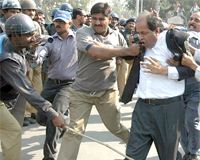
Washington (UPI) Nov 13, 2007 A close adviser to Pakistani President Pervez Musharraf promises full democracy will return to Pakistan by February 2008. However, given today's prevailing political climate, much can happen in the next three months that could either take the country on the road to political recovery or plunge it into greater chaos and potential civil war. Ahmad Raza Khan Qasuri, who counsels the Pakistani leader on constitutional decisions, told this reporter last week the extraordinary measures undertaken by Musharraf were "temporary." Qasuri called the imposition of the state of emergency a necessary step "to bring in stability and to maintain security of the country and to bring peace and sanity." Musharraf, he said, wants "complete civilian democracy." Musharraf would in the process take off his uniform and give up his position as commander in chief of the armed forces once the situation stabilizes. The first question that jumps to mind is who gets to decide when security and stability have returned sufficiently for free elections to be held? Musharraf, of course! So what happens if the president decides, as all autocratic rulers so often tend to do, that he wants to remain in power? All he needs to do is declare the security situation unstable, further delay elections, citing national security concerns, and retain his hold on power. Musharraf justified his coup by saying the security of Pakistan was at stake from extremist Islamists elements. Except the heads and bones being cracked by baton-wielding Pakistani riot policemen and the military were those of lawyers and judges, not Islamist fundamentalists trying to bring down the government. Musharraf's political opponents accuse him of having used the emergency rule he put into effect last weekend to postpone holding elections with a single goal in mind: retaining power. Qasuri blames the judiciary for exercising what he calls "judicial activism." It was the lawyers and judges who were bailing out hundreds of Islamists, he said. And they had to be stopped. In analyzing what is happening in Pakistan today, one cannot help but draw similarities with the events that unfolded in the streets of Tehran, Abadan and other Iranian cities prior to the Islamic revolution. The shah in Iran in 1979, much as Musharraf in Pakistan today, refused to come to face with the political realities taking place under his very nose. The shah, it can be said in his defense, was kept secluded behind his palace gates by close advisers who lied to him, telling him only what they thought he wanted to hear. Musharraf, on the other hand, has the advantage of knowing what is going on outside his palace gates, yet refuses to recognize it. The real danger is that the ingredients for an Islamic revolution, similar to the one that occurred in Iran, are all there. Consider the following: First: The overwhelming desire among all classes of society for political change; the urge to do away with the current crop of autocratic rulers and their often corrupt entourage. Second: The elite and the middle-class bourgeoisie, who tend to lean toward the West and want to see changes more in the shape of democratic reforms and free elections. Third: The presence of a large, often illiterate lower-working-class populace, easily influenced by the mullahs. Fourth: The largely negative role seen being played by the United States in Washington's unwavering support of a leadership that no longer fully represents the people. As with the shah in Iran then and the Pakistani president now, Washington is perceived as closing its eyes on human-rights abuses, ignoring what it preaches regarding basic democratic principles. Once again, Washington is seen as adopting double standards -- saying one thing but doing another. Seen from the streets of Tehran then and Islamabad now, the general feeling among the people is that Washington will continue to back Musharraf, as it backed the shah, until it is too late. Indeed, one wonders if Washington will recognize the symptoms of another Islamic revolt in the making. (Claude Salhani is editor of the Middle East Times.) (e-mail: Claude@metimes.com)
Community
 Dozen US rights groups ask Bush to cut off military aid to Pakistan
 Washington (AFP) Nov 13, 2007
A dozen US human rights groups on Tuesday urged President George W. Bush to cut off military aid to Pakistan if President Pervez Musharraf refuses to end emergency rule and release politicians, jurists and rights activists. |
|
|

| The content herein, unless otherwise known to be public domain, are Copyright 1995-2007 - SpaceDaily.AFP and UPI Wire Stories are copyright Agence France-Presse and United Press International. ESA Portal Reports are copyright European Space Agency. All NASA sourced material is public domain. Additional copyrights may apply in whole or part to other bona fide parties. Advertising does not imply endorsement,agreement or approval of any opinions, statements or information provided by SpaceDaily on any Web page published or hosted by SpaceDaily. Privacy Statement |