|
 |
 |
 |
 |
 |
 |
 |
 |
 |

| . |  |
. |
Analysis: India-U.S. Nuke Partnership
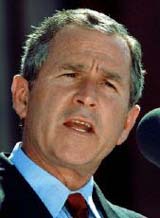
New Delhi (UPI) July 19, 2005 The reopening of civil nuclear technology to India would go a long way in cementing ties between the United States and Asia's emerging powerhouse, Indian analysts said Tuesday. "This decision will contribute toward meeting India's energy requirements when this country's economy is moving at a rapid pace," said Anand Kishore Sahay, a noted journalist and expert in foreign affairs. The public affirmation by the U.S. President Bush to support Indian civil nuclear and space programs was widely welcomed in the country. The understanding reached between the two countries in a summit meeting between Indian Prime Minister Manmohan Singh and Bush is being described as "a new chapter" in India-U.S. relations. Sahay called it "a very positive development." "This would will help the United States and India to build ties of a kind which have eluded the two important democracies over the last 40 years," he said. Terming India as "a diplomatic and economic partner," Bush said the two nations were working around the world to displace hatred and violence with prosperity, hope and optimism. India and United States have had an uneasy relationship as they were on opposite sides of the Cold War. The ties worsened when India first conducted nuclear tests in 1971 and later in May 1998, which led to U.S. sanctions. Since then, New Delhi has been making efforts to improve its relations with Washington and the opportunity came after the Sept. 11, 2001, attacks when the United States reached out to the world to launch its war on terror. India, a victim of terrorism for decades, joined the U.S.-led war on terror and the United States, realizing India's growing economic potential, has warmed up to the world's largest democracy. "The changed outlook of United States toward India's nuclear program will instill confidence in India toward America," Sahay said. He said the key reason why India in the past never allied with United States was the sense Washington was engaged in discriminatory behavior toward it in the areas of politics and technology transfer. G. Parthasarthy, a former Indian ambassador to Pakistan, also welcomed the changed attitude of Bush administration and said Bush was attempting to change America's non-proliferation policy. He said the U.S. policy had clouded its relations with India for decades. However, Parthsarthy added India should be treated on par with China. "There can be a genuine partnership between U.S. and India in the field of nuclear energy only when the U.S. treats India at par with China on the issue of its nuclear energy," he said. India has for a long time been seeking this breakthrough, which will contribute in India's recognition as a full-fledged nuclear weapons state. In return, New Delhi has expressed its commitment to remain a responsible nuclear weapon state. The new understanding reached between the two nations Monday would come into force in a phased manner by a new joint working group during the next few months. The U.S. exports of nuclear reactors, boilers, machinery and mechanical appliances and their parts to India totaled close to $1 billion in 2003-04, according to the Indian Commerce Ministry's data. These U.S. exports were almost one-fifth of all its exports to India in 2003-04 valued at $5.034 billion, said a senior Commerce Ministry official. The joint statement issued Monday was made possible as both Bush and Singh showed their determination and political will. Both had complex international negotiations to conduct before approaching a deal that has been elusive for years. The new thaw in India-U.S. relations will also help New Delhi in dealing with what it calls cross-border terrorism as Pakistan can no longer afford to walk out of the peace process. Another achievement for India is Bush had accepted India's stand on Kashmir being a bilateral issue between it and Pakistan. Islamabad has previously sough mediation. Bush said Kashmir had to be resolved through dialogue and praised the ongoing peace process between two South Asian nuclear armed rival. Of late, India has geared up its efforts to normalize relations with neighboring countries like Pakistan and China. After a breakthrough in India-U.S. relations in the field of civil nuclear energy, New Delhi is now waiting for a U.S. response to Pakistan's nuclear capabilities. Pakistan also conducted nuclear tests in 1998 and claimed to be a nuclear weapons state. The United States imposed sanctions against Pakistan at the time, but many of those measures were lifted when Islamabad actively participated the U.S. led war on terror.
Related Links  Washington (AFP) Jul 19, 2005
US President George W. Bush said Monday he would work for "full" civil nuclear cooperation with India and ask Congress to lift sanctions preventing Indian access to American nuclear technology. |
|
|

| The content herein, unless otherwise known to be public domain, are Copyright 1995-2006 - SpaceDaily.AFP and UPI Wire Stories are copyright Agence France-Presse and United Press International. ESA PortalReports are copyright European Space Agency. All NASA sourced material is public domain. Additionalcopyrights may apply in whole or part to other bona fide parties. Advertising does not imply endorsement,agreement or approval of any opinions, statements or information provided by SpaceDaily on any Web page published or hosted by SpaceDaily. Privacy Statement |