|
 |
 |
 |
 |
 |
 |
 |
 |
 |

| . |  |
. |
Analysis: N.Korea Unveils Disarmament Plan
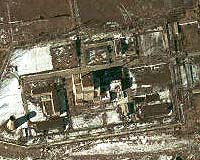
Seoul (UPI) Nov 14, 2005 North Korea recently proposed a five-step plan to gradually dismantle its nuclear weapons program, South Korea's chief security official said Monday. The proposal was made during six-nation talks on North Korea's nuclear drive in Beijing last week, Unification Ministry Chung Dong-young said at a meeting organized by a broadcasting journalists' club in Seoul. The fifth round of nuclear talks -- involving the two Koreas, the United States, Japan, Russia and China -- broke for recess Friday with no major progress after three days of talks. The delegates agreed to meet again at the "earliest possible date," but didn't set a date. Chung said the nuclear talks were "meaningful in that North Korea confirmed its readiness to give up its nuclear weapons program and presented its roadmap on nuclear dismantlement. "Some people have raised fundamental questions if North Korea is willing to give up its nuclear program," he said. "But in the latest round of talks, we have confirmed there is no disagreement among the six parties that the Korean peninsula should be free of nuclear weapons, and North Korea also confirmed this," Chung said. "North Korea has proposed a five-stage road map on nuclear dismantlement," he said. Under the five-step plan, North Korea said it would first halt any plans for nuclear tests and agreed not to transfer nuclear technology or materials to other nations, according to Chung. For the third stage, the North would agree not to produce additional atomic weapons and afterward suspend and later dismantle its nuclear program, subject to verification, Chung said. Finally, the North would also allow outside inspections of nuclear facilities and rejoin the nuclear non-proliferation treaty and safeguards under the International Atomic Energy Agency. Chung expressed optimism about the peaceful resolution of the nuclear standoff, which have raised tensions on the divided Korean peninsula for the past three years. "A big picture has been drawn up by the Sept. 19 joint statement issued at the end of the fourth round of talks. We have already agreed on which way to exit. We're just seeking ways from the entrance to the exit," Chung said, referring to the first formal document adopted at the end of the previous round of six-nation talks. The six-point statement reached on Sept. 19 calls for North Korea to abandon its existing nuclear weapons and all related programs as well as return to the NPT and admit safeguards of the IAEA "at an early date" in return for a security guarantee and economic benefits. In return, the North will benefit from energy aid, talks to normalize relations with the United States and Japan, negotiations on the provision of light-water reactors to the North "at an appropriate time" and the establishment of a peace regime on the Korean peninsula to replace the armistice which ended the three-year Korean War in 1953. But a day later the agreement, North Korea insisted it would not dismantle its nuclear arsenal before the United States supplied it with a light-water atomic reactor to generate electricity. The United States says North Korea must disarm first to resolve the standoff. In the news conference, Chung, the country's top security policymaker as the chief of the presidential National Security Council, also vowed his country would push for peaceful engagement with North Korea through expanded economic assistance. He reaffirmed Seoul's plan to supply energy-starved North Korea with 2 million kilowatts of electricity free if the communist country agrees to abandon its nuclear ambitions, a plan that triggered taxpayers' concerns. "Our proposal of electricity aid to North Korea has been the main driving force to keep the sic-nation talks on float," Chung said. The Unification Ministry decided to increase the inter-Korean cooperation fund by 110.3 percent to $2.52 billion next year to prepare for electricity aid and expand cross-border economic cooperation. In the long term, the Unification Ministry plans to spend $4.8 billion over the next few years on North Korea, in addition to existing humanitarian aid, such as food and fertilizer. In a further step, South Korea is ready to use 0.7 percent of its gross domestic product on North Korea to improve its infrastructure -- energy, transportation and telecommunications -- if and when Pyongyang's nuclear problem is resolved. South Korea's estimated GNP this year was $701 billion. Chung also expressed hope the ongoing Asia-Pacific Economic Cooperation forum hosted by South Korea will serve as an opportunity to ensure peace on the Korean peninsula. "North Korean delegates have not come to the APEC meeting, but South Korea will seek to cement peace on the peninsula through various bilateral summits and multilateral talks with participating countries during the APEC forum," he said. The APEC forum kicked off Saturday, with its leaders' summit slated for Nov. 18-19, where heads of state from 21 member economies are expected to discuss trade, anti-terrorism and the bird flu pandemic. Related Links SpaceDaily Search SpaceDaily Subscribe To SpaceDaily Express  Workers Strike At Top-Secret Israeli Nuclear Facility
 Jerusalem (AFP) Nov 14, 2005
Workers at Israel's controversial Dimona nuclear facility went on strike on Monday to protest at job losses at the top-secret plant. |
|
|

| The content herein, unless otherwise known to be public domain, are Copyright 1995-2006 - SpaceDaily.AFP and UPI Wire Stories are copyright Agence France-Presse and United Press International. ESA PortalReports are copyright European Space Agency. All NASA sourced material is public domain. Additionalcopyrights may apply in whole or part to other bona fide parties. Advertising does not imply endorsement,agreement or approval of any opinions, statements or information provided by SpaceDaily on any Web page published or hosted by SpaceDaily. Privacy Statement |