|
 |
 |
 |
 |
 |
 |
 |
 |
 |

| . |  |
. |
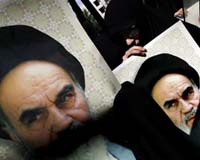
Analysis: Nearly 30 years of Islamic rule
Washington (UPI) Feb 11, 2008 Anniversaries offer an opportunity to take stock of one's accomplishments. This Monday marks the 29th year since the Islamic revolution ousted the shah of Iran, replacing the monarchy with a theocracy. Time to take stock and examine just what has been achieved in those three tumultuous decades by Iran, as it tried to export its revolution, and by the West in trying to counter the spread of Islamist influence. The first question one needs to ask when talking about Iran is whether the Islamic revolution is in fact still alive. Yes, the mullahs are still very much in control, and yes, a conservative (Mahmoud Ahmadinejad) won the last presidential elections. But how much can be attributed to the regime clinging on to power by making sure its opponents are severely dealt with? Every visitor to the Islamic republic comes back with the same story: that the majority of Iranians -- who by the way are under 25 years of age -- do not support the mullahs. Given the choice, a great number of those young people would vote with their imitation Nike-clad feet -- and emigrate. Preferred destination: the land of "the shaitan bazorg" or "Great Satan": the United States of America. It is important however for U.S. policymakers not to confuse the Iranians' lack of support for the ruling mullahs with a lack of patriotism. If attacked by a foreign power, Iranians will fight and die to defend their homeland, regardless of who governs them. In fact, an attack on Iran will immediately rally the people around the mullahs, giving them renewed vigor. A number of analysts believe that the Islamic regime would have never survived had it not been for the folly of Saddam Hussein launching war against Iran; a war that lasted eight years and brought eight years of respite to the revolution. The war with Iraq rekindled Iranian nationalism, just as threats of a possible U.S. and/or Israeli attack on the country's suspected nuclear building sites would have a similar effect. The reasons are simply enough. In order to survive, a revolution, any revolution, must keep going or it sputters, stops and dies. In Iran's case, try as they did to export the idea of an Islamic revolution, there were no takers. Why? Two reasons: first, Iranians are not Arab, they are Persian. Arabs are reluctant to accept Iranians (Persians) as leaders in the Arab Middle East. And second, the vast majority of Iranians are Shiites, whereas the vast majority of Arabs are Sunni Muslims. So in 29 years of trying to foment revolutions among its neighbors at the cost of billions of dollars and thousands of human lives, what has the Islamic republic to show for their travails? Minimum return for that sort of investment, to say the least. Indeed, after three decades of turmoil, starting with the 444-day occupation of the U.S. Embassy and the detention of 52 of its diplomats, besides very poor relations with the United States, Iran has yet to make concrete inroads in any Arab country. Well, almost. One may allow them three rather minor achievements. Iran's sole success in that respect has been its infiltration into Lebanon thanks to the presence of Hezbollah, a Shiite paramilitary organization, and the near absence of the Lebanese central government, primarily in the south. The other so-called success is in the Palestinian territories where Iranians have turned up to help Hamas, although the latter are Sunnis. But when you are desperately seeking allies, you take them wherever you can find them. Iraq of course came to the Iranians like manna from heaven when the United States invaded in 2003, toppling Saddam, Iran's worst enemy, and dissolving both the military and the dreaded Mokhabarat, the secret police, who until the invasion had managed to keep Iranian would-be infiltrators out. Perhaps the only real political or strategic victory for Iran has been its alliance with Syria, marking the first time such an agreement was signed between Persians and Arabs. But my personal assessment of the situation is that the new relationship between Tehran and Damascus is more a marriage of convenience than a love affair. And in looking at what the West has accomplished in those 29 years, most of which found Iran shunned by the international community, the answer is probably far less than Iran. The U.S. policy of not talking to Tehran has been as successful as the one applied to Cuba since its revolution in 1959 -- or, as was the case in the 1960s through the 1980s when U.S. diplomats were banned from having any direct contact with members of the Palestine Liberation Organization. The result then, just as the result now, is that it only prolongs the problem. Think for example if the State Department had entered into direct contact with the PLO in the days before Hamas came into being. Or before Iran started going nuclear. If there is one lesson to drawn from the silent-treatment policy, it is this: rarely, if ever, does it bear fruit. If anything can be learned from 30 years of not dealing with Iran, it's that the situation gets more complex with every passing year, let alone 29 years. Claude Salhani is Editor of the Middle East Times. Community Email This Article Comment On This Article Related Links Learn about nuclear weapons doctrine and defense at SpaceWar.com Learn about missile defense at SpaceWar.com All about missiles at SpaceWar.com Learn about the Superpowers of the 21st Century at SpaceWar.com
 Disagreements could delay Iran nuclear report: diplomats
 Vienna (AFP) Feb 11, 2008
The UN's latest widely-awaited report on Iran's nuclear programme could be delayed by disagreements between atomic watchdog chief Mohammed ElBaradei and his technical staff, diplomats said Monday. |
|
|

| The content herein, unless otherwise known to be public domain, are Copyright 1995-2007 - SpaceDaily.AFP and UPI Wire Stories are copyright Agence France-Presse and United Press International. ESA Portal Reports are copyright European Space Agency. All NASA sourced material is public domain. Additional copyrights may apply in whole or part to other bona fide parties. Advertising does not imply endorsement,agreement or approval of any opinions, statements or information provided by SpaceDaily on any Web page published or hosted by SpaceDaily. Privacy Statement |