
 |
 |
 |
 |
 |
 |
 |
 |
 |
 |

| . |  |
. |
Analysis: Venezuela offers oil to Paraguay
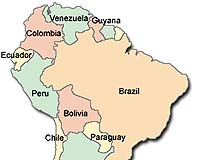
Miami (UPI) Aug 20, 2008 Venezuela will supply Paraguay "with all the oil it needs," said President Hugo Chavez, who welcomed the election of another leftist leader in Latin America. While officials with the Venezuelan state-run oil company PDVSA refused to give explicit details of the agreement, Chavez assured new Paraguayan President Fernando Lugo, a former bishop whose political leanings are in line with the leftist Chavez, that his country would have enough oil to stave off any future shortages. The deal would sell Paraguay 23,500 barrels per day of reduced-price oil. The poor South American country uses about 27,500 barrels a day, according to the U.S. Department of Energy. Paraguay has no domestic oil production. The decision by Chavez was seen by some as yet another political chess move by the Venezuelan leader in his continuing effort to forge stronger ties among the region's newly anointed leftist leaders. Paraguay joins several Latin American countries, including neighbors Brazil and Argentina, in electing leaders from the left. "The important payoff for Chavez is that the transaction projects a momentum that is entirely in his favor, i.e., another South American nation joins left-leaning countries," Larry Birns, director of the Council on Hemispheric Affairs, told United Press International. Over the last several years Chavez and Venezuelan energy officials have orchestrated numerous preferential oil and gas agreements. Last month Venezuela hammered out a deal whereby Spain would receive deeply discounted oil -- at $100 a barrel -- in exchange for medical materials and new technology. Chavez, who was visiting Europe at the time, called the $100 sale price offered to Spain "fair," noting that "Venezuela has never wanted oil to cost more than" that and that the $100 mark ultimately would be a favorable price per barrel on the international market. Awash with petrodollars, Venezuela has sought to expand its influence closer to home with the addition of Paraguay to the list of countries receiving preferential pricing. While Paraguay joins neighboring Bolivia and others benefiting from Venezuela's petroleum largesse, Venezuela is also actively currying favor in the Caribbean through its discount oil initiative known as Petrocaribe. Launched in 2005, the agreement allows Caribbean member nations to purchase Venezuelan oil at a deeply discounted price -- a deal that has alleviated many Caribbean nations' energy woes and lessened their dependence on U.S. financial aid. "Petrocaribe is one of Chavez's most important geopolitical tools in Latin America," read a report released last month by the Washington-based Latin Source think tank. Among Petrocaribe's biggest beneficiaries have been nations like Cuba, the Dominican Republic, Jamaica and Nicaragua. And in January, Chavez announced his country's decision to build a refinery on the Caribbean island of Dominica, part of his effort to further integrate the region's energy supplies. The Venezuelan president said Dominica's refinery would be a jumping-off point for distributing Venezuelan oil to other eastern Caribbean countries. In late 2007 Venezuela announced it would help Cuba get a Soviet-era oil refinery back online after decades of dormancy. The plant went back online with the help of Venezuela and some $136 million in repairs funded by Caracas; it is believed to be capable of processing some 65,000 barrels per day. Venezuela, meanwhile, sends about 100,000 bpd to Cuba at a discounted price, part of the Petrocaribe agreement. Cuban officials have lauded the return of operations at Camilo Cienfuegos, though some say the plant may still need work before becoming fully operational. But Chavez appears willing to spend the billions of dollars in state oil and gas revenue to exert his influence both closer to home and now across the Atlantic. Part of that effort is an ambitious gas pipeline proposal by Chavez that would stretch from northern Venezuela to the tip of South America, supplying Brazil, Uruguay and Argentina with Venezuelan gas. Critics of the multibillion-dollar proposal say a pipeline extending through thousands of miles of jungle thicket and desolate mountains would make the project prohibitively expensive, even for oil and gas revenue-rich Venezuela. (e-mail: [email protected]) Community Email This Article Comment On This Article Share This Article With Planet Earth
Related Links Powering The World in the 21st Century at Energy-Daily.com
 Oil giant Shell evacuates 425 staff amid Tropical Storm Fay
 London (AFP) Aug 18, 2008
Anglo-Dutch energy giant Royal Dutch Shell said Monday it had evacuated 425 staff from the Gulf of Mexico but added that no more workers would leave as Tropical storm Fay was set to avoid its facilities. |
|
|

| The content herein, unless otherwise known to be public domain, are Copyright 1995-2007 - SpaceDaily.AFP and UPI Wire Stories are copyright Agence France-Presse and United Press International. ESA Portal Reports are copyright European Space Agency. All NASA sourced material is public domain. Additional copyrights may apply in whole or part to other bona fide parties. Advertising does not imply endorsement,agreement or approval of any opinions, statements or information provided by SpaceDaily on any Web page published or hosted by SpaceDaily. Privacy Statement |
 del.icio.us
 Digg
Digg Reddit
 YahooMyWeb
 Google
 Facebook