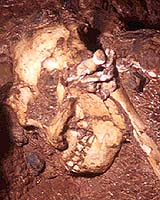
A fossilised example of the genus Australopithecus
A fossilised example of the genus Australopithecus |
Little Foot is of the genus Australopithecus, thought by some to be part of the ancestral line which led directly to man. But research by Dr Jo Walker and Dr Bob Cliff of the University of Leeds School of Earth and Environment, with Dr Alf Latham of Liverpool University's School of Archaeology, Classics and Egyptology, shows the remains are more than a million years younger than earlier estimates.
The team used uranium lead chronology to date the remains. Working on extracts of stalagmite deposits from immediately above and below the body, they dated the skeleton at around 2.2 million years old.
Their findings, published in the American journal Science, are controversial. Earlier estimates had put the age of Little Foot at three to four million years old placing it potentially on a direct line to humans.
The first recognisable stone tools appeared in Africa around 2.6 million years ago, but they were not made by Australopiths. Rather it is thought the first tool maker was Homo habilis, whose evolution is believed to have led directly to man. Rather than being older than Homo habilis - and a possible direct ancestor - Little Foot is more likely a distant cousin.
His remains are cemented in hard mineral deposits in the Sterkfontein cave complex which has yielded a number of other ancient finds. It is thought he either fell down a shaft or somehow got trapped in the cave and died there to be covered by the sediment layers from which he is now being slowly extracted. These sediments are themselves sandwiched between stalagmite layers which provided the materials for the dating process.
Australopithecus walked on two legs, but stood just 130cm tall and had a brain comparable in size with a modern chimpanzee. As Dr Walker explained: "In many of these finds, the smallest bones have disintegrated, but here the feet and hands are well preserved - and these could enable researchers to show how well adapted this early primate was to walking on two feet."
But the sediment encasing Little Foot is harder than the bone - making extracting him a painstaking process for the South African team.
And Drs Latham and Cliff have now turned their own attention to further Australopith findings at Makapansgat, also in South Africa, where other specimens of Australopithecus have been found.
Related Links
 Concrete Blocks Used In Great Pyramids Construction
 Philadelphia PA (SPX) Dec 05, 2006
| The content herein, unless otherwise known to be public domain, are Copyright 1995-2006 - SpaceDaily.AFP and UPI Wire Stories are copyright Agence France-Presse and United Press International. ESA PortalReports are copyright European Space Agency. All NASA sourced material is public domain. Additionalcopyrights may apply in whole or part to other bona fide parties. Advertising does not imply endorsement,agreement or approval of any opinions, statements or information provided by SpaceDaily on any Web page published or hosted by SpaceDaily. Privacy Statement |