|
 |
 |
 |
 |
 |
 |
 |
 |
 |

| . |  |
. |
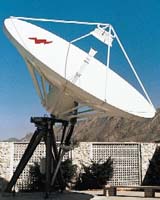
Andrew's Enhanced Earth Station Antennas Built To Withstand Powerful Winds
Westchester IL (SPX) Feb 06, 2006 Andrew Corporation has enhanced two of its most popular earth-station antennas to make them capable of withstanding the most intense hurricane-force winds. The company said its 4.5 meter and 9.4 meter High Wind Earth Station Antennas ensure minimal degradation of performance during high winds. They have the ability to survive in winds of up to 155 miles per hour in any position and speeds of up to 200 miles per hour in the stowed position. Andrew's Satellite Communications Group provides antennas from 43 centimeters to 11.5 meters, and cover C, Ku, K, X, and the emerging Ka bands. The products include type approved earth station antenna hubs and gateways for broadband and broadcast, VSAT broadband antennas for consumer and enterprise customers, DBS antennas for home satellite broadcast systems, and complete installation and testing services. The company said it will showcase its various satellite communications offerings February 7-9 at SATELLITE 2006 in Washington, D.C. Related Links Andrew Corporation  SGI Supercomputer Helps Hungarian Meteorologists Undertstand Complex Weather
 Atlanta GA (SPX) Feb 01, 2006
With an eye on developing more detailed and complex models to deliver increasingly accurate short-range weather forecasts, the Hungarian Meteorological Service (HMS) is investing in a scalable, high-performance SGI Altix supercomputer from Silicon Graphics. |
|
|

| The content herein, unless otherwise known to be public domain, are Copyright 1995-2006 - SpaceDaily.AFP and UPI Wire Stories are copyright Agence France-Presse and United Press International. ESA PortalReports are copyright European Space Agency. All NASA sourced material is public domain. Additionalcopyrights may apply in whole or part to other bona fide parties. Advertising does not imply endorsement,agreement or approval of any opinions, statements or information provided by SpaceDaily on any Web page published or hosted by SpaceDaily. Privacy Statement |