|
 |
 |
 |
 |
 |
 |
 |
 |
 |

| . |  |
. |
Armored Bubbles Can Exist In Stable Non Spherical Shapes
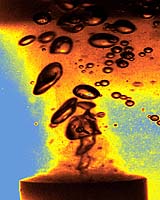
Boston MA (SPX) Dec 15, 2005 Researchers at Harvard University have demonstrated that gas bubbles can exist in stable non-spherical shapes without the application of external force. The micron- to millimeter scale peapod-, doughnut- and sausage-shaped bubbles, created by coating ordinary gas bubbles with a tightly packed layer of tiny particles and then fusing them, are described this week on the web site of the journal Nature. "Particles have been used to stabilize emulsions and foams for over 100 years," says lead author Anand Bala Subramaniam, a research associate in Harvard's Division of Engineering and Applied Sciences who conducted much of the work before receiving his undergraduate degree from Harvard College last June. "However, we've demonstrated that not only are particles useful for making bubbles last longer, they fundamentally alter the properties of these bubbles. Instead of behaving like a fluid surface that flows to balance unequal stresses, the 'armor' of particles on the surface of the bubbles actually supports the unequal stresses inherent in non-spherical shapes." Surface tension gives all bubbles and drops their perfectly spherical shape by minimizing the surface area for a given volume. Ordinarily if two bubbles are fused, the product is a larger but still spherical bubble. But when particles are strongly anchored to the bubble surface and the bubbles are fused, a stable sausage shape is produced. "The bubble wants to reduce its surface area by going back to a spherical shape, but the strong anchoring of the particles on the surface prevents their expulsion," Bala Subramaniam says. "The particles end up tightly packed, and eventually push against each other strongly, allowing the bubble surface to carry forces to support a non-spherical shape." Although the particles are jammed, they are not bonded to each other, Bala Subramaniam adds. It is this absence of permanent bonds that allowed the researchers to reshape and remold the initially sausage-shaped bubbles into peapods, disks and donuts. The phenomenon of irregularly shaped bubbles has been observed in nature; air bubbles in impure ocean water are often non-spherical, their shapes distorted by surface dirt. The concepts of jamming and non-spherical shapes may also be useful for understanding other systems such as biological membranes. Bala Subramaniam and his colleagues have found particle jamming on surfaces to be a general phenomenon compatible with a wide range of particle coatings, including polystyrene, polymethylmethacrylate, gold and zirconium oxide. Both particle and bubble size can vary widely, with the largest armored bubbles roughly 10,000 times the size of the smallest. "We have provided a general explanation of why these non-spherical bubbles can be observed," says co-author Howard A. Stone, Bala Subramaniam's advisor and the Vicky Joseph Professor of Engineering and Applied Mathematics at Harvard. "Bubbles are engineered into many consumer products. The ability to alter the shapes of bubbles and liquid drops in products like ice cream or shaving foams or creams may provide a means to alter the consistency or texture of these products. The non-spherical bubbles could also find use as vessels for delivering drugs, vitamins or flavors."
Bala Subramaniam and Stone's co-authors are Manouk Abkarian and Lakshminarayanan Mahadevan of Harvard's Division of Engineering and Applied Sciences. Their work was supported by Unilever. Related Links Harvard University Division of Engineering and Applied Sciences SpaceDaily Search SpaceDaily Subscribe To SpaceDaily Express  The Flimsiest Clock In The World
 Tokyo (AFP) Dec 15, 2005
A Japanese watchmaker said Thursday it had created the world's first flexible digital clock which is as thin as camera film and can be bent around the curve of a wall. |
|
|

| The content herein, unless otherwise known to be public domain, are Copyright 1995-2006 - SpaceDaily.AFP and UPI Wire Stories are copyright Agence France-Presse and United Press International. ESA PortalReports are copyright European Space Agency. All NASA sourced material is public domain. Additionalcopyrights may apply in whole or part to other bona fide parties. Advertising does not imply endorsement,agreement or approval of any opinions, statements or information provided by SpaceDaily on any Web page published or hosted by SpaceDaily. Privacy Statement |