|
 |
 |
 |
 |
 |
 |
 |
 |
 |

| . |  |
. |
Black Holes In Feeding Frenzy
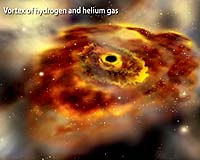
Honolulu, HI (SPX) Aug 06, 2007 Two UH astronomers using the Hubble Space Telescope believe they have identified what makes at least some quasars shine: the black hole at the center of a massive galaxy with little gas of its own is gobbling up material from a colliding gas-rich galaxy. The merging of two galaxies has long been thought to be an efficient way of driving gas deeply into a galaxy to feed the central black hole, but there was only indirect evidence for such a mechanism until now. It was already known that quasars, which are among the most powerful objects in the Universe, lie at the centers of giant galaxies and consist of a massive black hole surrounded by a vortex of gas. Before the gas falls into the black hole, it spins faster and faster, and its temperature rises until it is hot enough to radiate up to a trillion times the power from the Sun. The question that graduate student Hai Fu and astronomer Alan Stockton tried to answer is, "Where is the gas coming from?" To answer the question, Fu and Stockton used a telescope-mounted spectroscope to find out what the gas is made of. "We found that the gas that is spiraling into the black hole is almost pure hydrogen and helium, whereas the stars and other material in the surrounding giant galaxy are heavily contaminated by other elements such as carbon and oxygen," said Fu. This difference implies that the infalling gas has recently come from outside the galaxy, most likely from another galaxy that is merging with the giant one. Fu and Stockton also see a chaotic distribution of fast-moving patches of relatively pure hydrogen and helium scattered around the quasar, implying that black holes not only swallow things, but can also expel a large portion of their meal out to thousands of light-years away, likely through an energetic blast that happened millions of years ago. Fu and Stockton did their research at the UH Institute for Astronomy in Manoa valley using data from the Hubble Space Telescope, which is in orbit around Earth, and from the telescopes on Mauna Kea, the Big Island. Their work has been published in the August 1 issue of the Astrophysical Journal Letters. Community Email This Article Comment On This Article Related Links Institute for Astronomy, University of Hawaii at Manoa Understanding Time and Space
 Hidden Order Found In A Quantum Spin Liquid
 London UK (SPX) Jul 31, 2007
An international team, including scientists from the London Center for Nanotechnology, has detected a hidden magnetic "quantum order" that extends over chains of 100 atoms in a ceramic without classical magnetism. The findings have implications for the design of devices and materials for quantum information processing. In quantum information processing, data is recorded and manipulated as quantum bits or 'qubits', generalizations of the classical '0' and '1' bits which are traditionally represented by the 'on' and 'off' states of conventional switches. It is widely believed that if large-scale quantum computers can be built, they will be able to solve certain problems, such as code breaking, exponentially faster than classical computers. |
|
|

| The content herein, unless otherwise known to be public domain, are Copyright 1995-2007 - SpaceDaily.AFP and UPI Wire Stories are copyright Agence France-Presse and United Press International. ESA Portal Reports are copyright European Space Agency. All NASA sourced material is public domain. Additional copyrights may apply in whole or part to other bona fide parties. Advertising does not imply endorsement,agreement or approval of any opinions, statements or information provided by SpaceDaily on any Web page published or hosted by SpaceDaily. Privacy Statement |