|
 |
 |
 |
 |
 |
 |
 |
 |
 |

| . |  |
. |
Boeing-Built Spaceway 3 Satellite Operational After Launch
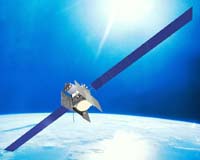
St Louis MO (SPX) Aug 16, 2007 Boeing announced that it has sent and received the first on-orbit commands from the Boeing-built Spaceway 3 satellite following a successful launch of the spacecraft. All data shows that Spaceway 3 is healthy and operating normally. An Ariane 5 rocket lifted the Hughes Network Systems, LLC payload into space yesterday at 7:44 p.m. EDT (23:44 GMT) from Ariane Launch Complex 3 in the tropics of Kourou, French Guiana. Boeing's Mission Control Center in El Segundo, Calif., reported spacecraft acquisition five hours, 46 minutes later, when signals were received at the ground station in Hartebeesthoek, South Africa. "Boeing is helping Hughes in its vision to 'Connect to the Future' through satellite-based Internet services," said Howard Chambers, vice president and general manager of Boeing Space and Intelligence Systems. "Flying more than 22,000 miles above North America, the Spaceway 3 satellite will allow Hughes Network Systems to provide existing and new customers with high-speed, two-way communications for Internet, data, voice, video and multimedia applications." Boeing manufactured the high-power, 702 satellite operating in Ka-band to enable Hughes to provide customers a new range of broadband-via-satellite services throughout North America. The Boeing-built technology that will enable these services includes a digital processor, downlink phased array antenna, microwave switch matrix, and flight hardware and software that will provide point-to-point and point-to-multi-point connectivity to Hughes' customers. Over the next several months, Boeing will work with Hughes to complete on-orbit testing and deployment of the spacecraft's 132-foot solar arrays, as well as satellite check-out and system acceptance. Hughes then will place the satellite into commercial operation, providing advanced HughesNet services. Boeing has built more than 200 satellites since 1963 and continues to pioneer technologies and discover new applications that make a difference in the world today and create possibilities for tomorrow. Community Email This Article Comment On This Article Related Links Hughes Network Systems Integrated Defense Systems Space Technology News - Applications and Research
 ATK To Build Satellite Link Signal Generator With Sandia National Laboratories
 Minneapolis MN (SPX) Aug 09, 2007
Alliant Techsystems has reported that its Mission Research and Technical Services (MRTS) business division has been awarded a $2.8 million dollar contract by Sandia National Laboratories to build a unique multi-channel test source for the U.S. Nuclear Detection System (NDS) program, with disturbed channel capabilities. The enhanced testing source substantially expands the scope of earlier modeling and simulation analysis work to include hardware development. |
|
|

| The content herein, unless otherwise known to be public domain, are Copyright 1995-2007 - SpaceDaily.AFP and UPI Wire Stories are copyright Agence France-Presse and United Press International. ESA Portal Reports are copyright European Space Agency. All NASA sourced material is public domain. Additional copyrights may apply in whole or part to other bona fide parties. Advertising does not imply endorsement,agreement or approval of any opinions, statements or information provided by SpaceDaily on any Web page published or hosted by SpaceDaily. Privacy Statement |