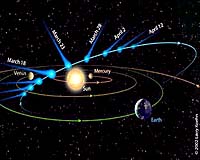
Bright Comet Graces Northern Skys
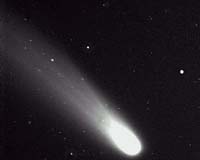
An image of Comet Ikeya-Zhang on the evening of Thursday, March 22, 2002, taken by the MicroObservatory telescope in Cambridge. The MicroObservatory project, created by the Science Education group at the Harvard-Smithsonian Center for Astrophysics, allows students and teachers across the nation to use telescopes over the Internet to take pictures of objects in the night sky. |
Boston - Mar 22, 2002
The brightest comet since 1997's Hale-Bopp is currently gracing the western skies of North America. Comet Ikeya-Zhang (pronounced "ee-KAY-uh JONG") was discovered on February 1st by two amateur astronomers in Japan and China, respectively.
Calculations of the comet's orbit by Brian Marsden of the Harvard-Smithsonian Center for Astrophysics show that it was last seen in 1661. This makes Ikeya-Zhang the first long-period comet (a comet with a period longer than 200 years) to be identified on its return to the inner solar system.
No telescope is necessary to look at this beautiful visitor as it swings around the Sun and heads back to deep space. The comet has brightened to naked-eye visibility, but is easiest to see through binoculars.

| The content herein, unless otherwise known to be public domain, are Copyright 1995-2006 - SpaceDaily.AFP and UPI Wire Stories are copyright Agence France-Presse and United Press International. ESA PortalReports are copyright European Space Agency. All NASA sourced material is public domain. Additionalcopyrights may apply in whole or part to other bona fide parties. Advertising does not imply endorsement,agreement or approval of any opinions, statements or information provided by SpaceDaily on any Web page published or hosted by SpaceDaily. Privacy Statement |
|