. Earth Science News .
Bright Comet Meets Bright Galaxy

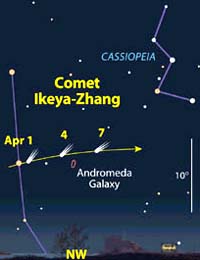
The path of Comet Ikeya-Zhang during early April. Now receding from the Sun, the comet is gradually sliding northward in the sky. On the evening of April 4th it passes within 1.5 degrees of the great Andromeda Galaxy. By mid-April it will be near enough to Polaris, the North Star, that observers at mid-northern latitudes will be able to view it virtually all night. The chart is plotted for an observer at 40� north latitude. Sky & Telescope diagram.
  • More Charts at Sky & Telescope

  • Los Angeles - Apr 02, 2002
    Amateur astronomers throughout the Northern Hemisphere have marked Thursday, April 4th, on their calendars. That evening, weather permitting, they'll be looking low in the northwest after sunset to spot a bright comet very near the famous Andromeda Galaxy. The comet, which was discovered on February 1st, is named Ikeya-Zhang [pronounced "ee-KAY-uh JONG"] for the two keen-eyed skygazers who first spotted it.

    Remarkably, both the comet and the galaxy are visible to the unaided eye -- at least for anyone with clear, dark skies far from the pall of city lights. The view through binoculars or a small telescope should be especially rewarding, as these two celestial spectacles crowd into the same field of view.

    According to Sky & Telescope magazine, on that evening the comet passes within 1.5 degrees of the galaxy's center. Comet Ikeya-Zhang will then be 82 million kilometers (51 million miles) from Earth, while the Andromeda Galaxy lies 300 billion times farther away (2.5 million light-years).

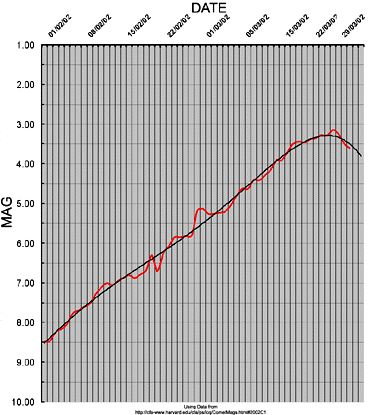
    Even though it passed closest to the Sun on March 18th, Comet Ikeya-Zhang has remained steady in brightness for the past two weeks, delighting skywatchers with its starlike nucleus and delicate, wispy tail.


    Related Links
    More at Sky & Telescope
    SpaceDaily
    Search SpaceDaily
    Subscribe To SpaceDaily Express

    Last Chance To See Comet Ikeya-Zhang
    Los Angeles - Mar 31, 2002
    Night owls and early birds can catch a glimpse of Comet Ikeya-Zhang as it passes by Earth in the next few weeks on its four-century journey around the Sun.


  • The First Envisat Check-Up On The Earth
  • Digital Photos From Solar Airplane To Improve Coffee Harvest
  • Jeppesen To Supply Worldwide Aviation Weather For Merlin Satellite Broadcast Service
  • Jason 1 Ready For Service, Releases First Data

  • World-Class Energy Centre Launched
  • Beacon Power Installs Its Next Generation 6kWh Flywheel System At WinDBreak Cable
  • More Reliable Power Sought


  • Customer Takes Control Of Thuraya
  • Boeing to Ship NASA's Tracking and Data Relay Satellite to Florida for March Launch
  • Eutelsat Boosts Hispasat Stake To 27 Percent
  • Intelsat Secures Launch Services For Intelsat X Series Satellites


  • The content herein, unless otherwise known to be public domain, are Copyright 1995-2006 - SpaceDaily.AFP and UPI Wire Stories are copyright Agence France-Presse and United Press International. ESA PortalReports are copyright European Space Agency. All NASA sourced material is public domain. Additionalcopyrights may apply in whole or part to other bona fide parties. Advertising does not imply endorsement,agreement or approval of any opinions, statements or information provided by SpaceDaily on any Web page published or hosted by SpaceDaily. Privacy Statement