






. Earth Science News .
Cassini Images Reveal Spectacular Evidence Of An Active Moon

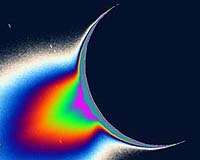
Recent Cassini images of Saturn's moon Enceladus backlit by the sun show the fountain-like sources of the fine spray of material that towers over the south polar region. Image credit: NASA/JPL/Space Science Institute.

Pasadena CA (JPL) Dec 07, 2005
Jets of fine, icy particles streaming from Saturn's moon Enceladus were captured in recent images from NASA's Cassini spacecraft. The images provide unambiguous visual evidence that the moon is geologically active.

"For planetary explorers like us, there is little that can compare to the sighting of activity on another solar system body," said Dr. Carolyn Porco, Cassini imaging team leader at the Space Science Institute in Boulder, Colo.

"This has been a heart-stopper, and surely one of our most thrilling results."

The Cassini images clearly show multiple jets emanating from the moon's south polar region. Based on earlier data, scientists strongly suspected these jets arise from warm fractures in the region. The fractures, informally dubbed "tiger stripes," are viewed essentially broadside in the new images.

The fainter, extended plume stretches at least 186 kilometers (300 miles) above the surface of Enceladus, which is only 186 kilometers wide. Cassini flew through the plume in July, when it passed a few hundred kilometers above the moon.

During that flyby, Cassini's instruments measured the plume's constituent water vapor and icy particles.

Imaging team members analyzed images of Enceladus taken earlier this year at similar viewing angles. It was a rigorous effort to demonstrate that earlier apparitions of the plumes, seen as far back as January, were in fact real and not due to imperfections in the camera.

The recent images were part of a sequence planned to confirm the presence of the plumes and examine them in finer detail. Imaging team member Dr. Andrew Ingersoll from the California Institute of Technology, said, "I think what we're seeing are ice particles in jets of water vapor that emanate from pressurized vents. To form the particles and carry them aloft, the vapor must have a certain density, and that implies surprisingly warm temperatures for a cold body like Enceladus."

Imaging scientists are comparing the new views to earlier Cassini data in hopes of arriving at a more detailed, three-dimensional picture of the plumes and understanding how activity has come about on such a small moon. They are not sure about the precise cause of the moon's unexpected geologic vitality.


Related Links
Caltech
Cassini-Huygens at JPL
Cassini Imaging Team
SpaceDaily
Search SpaceDaily
Subscribe To SpaceDaily Express

Rivers On Titan, One Of Saturn's Moons, Resemble Those On Earth
Champaign IL (SPX) Dec 06, 2005
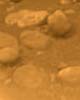
Recent evidence from the Huygens Probe of the Cassini Mission suggests that Titan, the largest moon orbiting Saturn, is a world where rivers of liquid methane sculpt channels in continents of ice. Surface images even show gravel-sized pieces of water ice that resemble rounded stones lying in a dry riverbed on Earth.


  • UN Ready To Feed Pakistani Quake Survivors Through Winter
  • UNHCR Braces For Exodus Of Mountain-Dwellers Who Survived SAsia Quake
  • Health Impact Of Hurricane Katrina Lingers Three Months Later
  • New Orleans Opens Final Devastated Neighborhood To Residents

  • UN Climate Summit Marked By Warnings, US Under Fire
  • Temperate Forests Could Worsen Global Warming
  • Modeling Of Fossil Fuel Consumption Shows 14 Degree Hike In Temperature
  • Warming Could Free Far More Carbon From High Arctic Soil

  • Unprecedented View Of Upper Atmosphere Created By NASA Scientists
  • Space Radar Advances And Application
  • Aerosonde Successfully Completes Weatherscout GUAM Trials
  • Landsat 5 Back-Up Solar Array Drive Having Technical Problems

  • Harnessing The Heating And Cooling Powers Of The Sun
  • Is The Flow Of Oil Assured
  • Fuel Cells Could Save Air Force Thousands
  • Poison + Water = Hydrogen. New Microbial Genome Shows How

  • Possible Human Transmission Of Bird Flu Investigated
  • Indonesia's Health System Fumbles As Bird Flu Spectre Looms
  • US Prepares For Bird Flu
  • Needle Free Immunizations

  • Lions And Tigers Are Unfair Game On Spanish Safaris
  • New Bacterial Genome Sequenced From Ancient Salterns
  • How A Cellular Spacecraft Opens Its Airlock
  • New Study Examines Evolutionary Explanations For Biological Immortality

  • Tehran Shut Down Amid Unprecedented Smog Alert
  • Dike To Defend Russian City From Chinese Toxic Slick Nearly Built
  • China Forms Team To Investigate Cause Of Lethal Toxic Spill
  • Health Alert As Iranian Capital Chokes In Smog

  • New Maps Reveal True Extent Of Human Footprint On Earth
  • Distinct Brain Regions Specialized For Faces And Bodies
  • NSF Funds Probe Of The Quintessence Of Surprise
  • Imaging Technique Visualizes Effects Of Stress On Human Brain

  • The content herein, unless otherwise known to be public domain, are Copyright 1995-2006 - SpaceDaily.AFP and UPI Wire Stories are copyright Agence France-Presse and United Press International. ESA PortalReports are copyright European Space Agency. All NASA sourced material is public domain. Additionalcopyrights may apply in whole or part to other bona fide parties. Advertising does not imply endorsement,agreement or approval of any opinions, statements or information provided by SpaceDaily on any Web page published or hosted by SpaceDaily. Privacy Statement