 |
 |
 |
 |
 |
 |
 |
 |
 |
 |

| . |  |
. |
Chandra Finds Heat At Center Of Andromeda
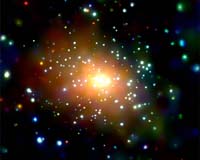
Cambridge MA (SPX) Jun 13, 2006 This color-coded image by NASA's Chandra X-ray Observatory - red means low energy, green means medium energy and blue means high-energy X-rays - shows the central region of the Andromeda Galaxy, also known as M31, where a diffuse, X-ray emitting cloud of hot gas was discovered in the midst of a collection of point-like sources. Analysis of the X-ray data shows the point sources are associated with binary star systems that contain a neutron star or black hole that is pulling matter away from a normal star. As the matter falls toward the neutron star or black hole, it is heated by frictional forces to tens of millions of degrees, and produces X-rays. The diffuse X-ray cloud is due to gas that has accumulated in the central region and been heated to millions of degrees, probably by shock waves from supernova explosions. The energy input from the supernovas could also be driving gas out of the central region. This process may affect both the shape and evolution of the galaxy by depleting the raw material for the formation of new stars and preventing more gas from accumulating there. Andromeda, a large spiral galaxy much like the Milky Way, is relatively nearby and can be easily seen with binoculars in the autumn sky. The galaxy's central region is called the galactic bulge because the stars form a ball a few thousand light years in diameter that extends above and below the disk of the galaxy. Related Links Chandra  A Tale Of Two Nebulae
 Calgary, Alberta (SPX) Jun 07, 2006
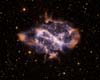
Two new images from Gemini Observatory show a pair of beautiful nebulae created by two very different types of stars at what may be similar points in their evolutionary timelines. One is a rare type of very massive spectral-type "O" star. It is surrounded by material it ejected in an explosive event earlier in its life and it continues to lose mass in a steady stellar wind. |
|
|

| The content herein, unless otherwise known to be public domain, are Copyright 1995-2006 - SpaceDaily.AFP and UPI Wire Stories are copyright Agence France-Presse and United Press International. ESA PortalReports are copyright European Space Agency. All NASA sourced material is public domain. Additionalcopyrights may apply in whole or part to other bona fide parties. Advertising does not imply endorsement,agreement or approval of any opinions, statements or information provided by SpaceDaily on any Web page published or hosted by SpaceDaily. Privacy Statement |