|
 |
 |
 |
 |
 |
 |
 |
 |
 |

| . |  |
. |
Clemson Inflatable Fabric Airlock Breezes Through Initial Tests
Clemson - May 27, 2003 Space just got skinnier: an inflatable fabric airlock could become standard equipment on future space stations after breezing through its prototype testing in April. The inflatable airlock, developed in conjunction with Clemson University's Clemson Apparel Research, is a prototype designed to permit astronauts to exit from vehicles and structures into space. It's part of NASA Johnson Space Center's Advanced Inflatable Airlock (AIA) program. When inflated, the nearly 10-foot tube is 50 percent bigger than the hardwall-construction airlock currently in use. Its greatest benefit, however, is what isn't there. When deflated, it's only one-quarter the volume of the current space shuttle airlock. "New fibers and fabric designs are revolutionizing how architects and designers think about structures," said Christine Jarvis, a Clemson faculty member and director of Clemson Apparel Research (CAR). CAR, which began as a demonstration facility for the U.S. Department of Defense, has developed products ranging from chemical-resistant suits and supply chain software to gloves that are virtually impervious to razor wire typically found in combat zones. The two-layer fabric airlock is made of about 180 pounds of fabric sandwiched on either end by metal hatches that together weigh a whopping 3,200 pounds. The internal layer is the bladder, which holds the air. The external restraining layer, manufactured by A&P Technology, is the largest structural braid ever produced. "We could not have designed and built this structure even five years ago," said Jarvis. "Typically, seams limit the strength of fabric structures, so we decided to eliminate them. It seems ironic that the state-of-the-art sewing facility was the group that figured out how to eliminate seams. Our engineers and designers constantly think of novel ways to solve problems." Future earth-bound uses for the material could include any large engineered products, such as domed covers for stadiums, said Jarvis. Honeywell is the prime contractor for the AIA program. Subcontractors include Clemson, Cincinnati-based A&P Technology, New York-based FTL Design Studio and Charlotte-based Celanese Advanced Materials. The airlock was designed by and CAR and FTL. The braid was designed by CAR, FTL and A&P CAR designed and manufactured the other fabric components, such as the bladder. Engineers from NASA and Honeywell tested the airlock at four atmospheres of internal pressure, which means it withstood a terrestrial tensile force of about 675,000 pounds on its equator. The airlock braid was produced on A&P Technology's 800 carrier Megabraider, currently the largest braid machine in the world. The manufacture and test of the airlock is the culmination of a two-year development effort that also included coupon and subscale tests. Related Links A&P Technology Clemson SpaceDaily Search SpaceDaily Subscribe To SpaceDaily Express  When Is A Metal Not A Metal
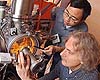 Gainsville - May 27, 2003
Niobium clusters display non-metallic properties at ultra-cold temperatures The May 23 issue of the journal Science answers that question with an account of the surprising behavior exhibited by nanometer-scale clusters of the metal niobium. |
|
|

| The content herein, unless otherwise known to be public domain, are Copyright 1995-2006 - SpaceDaily.AFP and UPI Wire Stories are copyright Agence France-Presse and United Press International. ESA PortalReports are copyright European Space Agency. All NASA sourced material is public domain. Additionalcopyrights may apply in whole or part to other bona fide parties. Advertising does not imply endorsement,agreement or approval of any opinions, statements or information provided by SpaceDaily on any Web page published or hosted by SpaceDaily. Privacy Statement |