|
 |
 |
 |
 |
 |
 |
 |
 |
 |

| . |  |
. |
Computer Model Can Predict Solar Weather
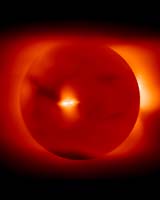
Durham NH (SPX) Jun 27, 2006 The most true-to-life computer simulation ever made of the Sun's multi-million-degree outer atmosphere, the corona, has successfully predicted its actual appearance during a solar eclipse last March 29. Scientists said the research, funded by NASA and the National Science Foundation, marks the beginning of a new era in space weather prediction. "This confirms that computer models can describe the physics of the solar corona," said lead researcher Zoran Mikic of Science Applications International Corp. in San Diego, Calif. Mikic and colleagues presented their research Monday at the American Astronomical Society's Solar Physics Division meeting. The turbulent corona is threaded with magnetic fields generated beneath the visible solar surface. The evolution of these magnetic fields causes violent eruptions and solar storms originating in the corona. Like a rubber band twisted too far, solar magnetic fields suddenly snap to a new shape, blasting billions of tons of plasma into space at millions of miles per hour as a phenomenon called a coronal mass ejection, or exploding with the force of up to 1 billion one-megaton nuclear bombs as a solar flare. When directed at Earth, solar flares and CMEs can disrupt satellites, communications and power systems. By accurately simulating the behavior of the corona, scientists hope eventually to predict when it will produce flares and CMEs, just like the National Weather Service uses computer simulations of Earth's atmosphere to predict when it will produce thunderstorms or hurricanes. Such predictions will be required to undertake NASA's Vision for Space Exploration, because radiation from flares and CMEs is hazardous to unprotected astronauts. A prediction will allow time for astronauts to take shelter in a radiation-shielded area. The new corona simulation is the beginning of that capability, according to the research team. It can predict the large-scale appearance of the corona, but it can't yet forecast smaller, local events like flares and CMEs. The computer model was based on spacecraft observations of magnetic activity on the Sun's surface, which affects and shapes the corona above it. The observations were made with the Michelson Doppler Imager instrument on NASA's Solar and Heliospheric Observatory. The SAIC team released simulated photographs of the March 29 solar eclipse 13 days before and five days before the eclipse occurred. During a total solar eclipse, the Moon blocks direct light from the Sun, so the much fainter corona is visible. This is the only time the corona is visible from Earth without special instruments, and it resembles a white, lacy veil surrounding the black disk of the Moon. Because the corona is always changing, each eclipse looks different. Just as fashion designers stake their reputations on showing the right look on the runway, the team staked its reputation on the right look for the corona - the accuracy of the simulation. The simulated photographs closely resembled actual photos of the eclipse, "providing reassurance that the model may one day be able to predict space weather events," Mikic said. Previous simulations were based on simplified models, so the calculations could be completed in a reasonable time by computers available then. The new simulation is the first to base its calculations on the physics of how energy is transferred in the corona. The researchers used NASA's Columbia and the National Science Foundation's Data Star supercomputers, which are called massively parallel arrays, because they employ many processors simultaneously to solve a problem. The supercomputers provided the most physically accurate simulations to date of the Sun's outer atmosphere. Even with their computing power, the calculations required four days to complete on about 700 processors.
Related Links SOHO  Astronomers Discover Space Is Fizzing
 Paris, France (SPX) Jun 21, 2006
Space is fizzing. In a place where Earth's magnetic field meets the constant stream of gas from the Sun, astronomers have found thousands of bubbles of superheated gas constantly growing and popping. The discovery could allow scientists finally to understand the interaction between the solar wind and the Earth's magnetic field. |
|
|

| The content herein, unless otherwise known to be public domain, are Copyright 1995-2006 - SpaceDaily.AFP and UPI Wire Stories are copyright Agence France-Presse and United Press International. ESA PortalReports are copyright European Space Agency. All NASA sourced material is public domain. Additionalcopyrights may apply in whole or part to other bona fide parties. Advertising does not imply endorsement,agreement or approval of any opinions, statements or information provided by SpaceDaily on any Web page published or hosted by SpaceDaily. Privacy Statement |