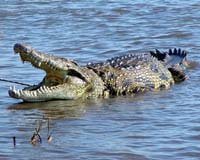
With global temperatures generally on the rise, crocodiles may have a harder time finding mates. For crocodiles, gender is not determined genetically, but rather by embryo temperature during incubation, notes Earthwatch-supported scientist Dr. Alison Leslie, of South Africa's University of Stellenbosch.
In an interview with three teenagers on a mission to find out about their planet, the subject of the new film A Year on Earth, Leslie explained how global warming could affect crocodile populations worldwide.
"A difference of 0.5 - 1C in incubation temperature results in markedly different sex ratios," says Leslie, principal investigator of Earthwatch's Crocodiles of the Okavango Delta project. Research shows that nest temperatures of about 32-33 degrees Celsius result in males, while temperatures higher and lower result in females. Temperatures within a nest can vary from the top to the bottom of the nest, and can result in mixed-gender hatchlings.
"More female hatchlings due to the cooler or hotter incubation temperatures could lead to eventual extirpation of the species from an area," says Leslie.
The three teens, Jamie (18), Arsen (17), and Tyler (16), visited Leslie at her camp in the Okavango Delta, Botswana, where they acted as field research assistants on Leslie's Earthwatch-supported research expedition. Their participation was part of a feature-length documentary, A Year on Earth, that will air on the Discovery Kids Channel in December.
The teens helped Leslie trap and examine Nile crocodiles big and small to monitor their diet, health, movements, and reproductive biology. Crocodile populations have dwindled dramatically in Botswana, due to overexploitation by hide hunters and conflicts with nearby communities.
"Even though crocodilians have been around for millions of years, and as important as these creatures may be in the systems they occupy, they are a much understudied species," says Leslie. For more than eight years, in both Botswana and South Africa, Leslie has been working with the support of Earthwatch Institute to change that.
In 2007, Leslie will leave behind her Okavango research camp (in the capable hands of staff member Sven Bourquin), and will embark on a new study of the crocodiles along Zambia's Zambezi River. Earthwatch volunteers will continue to assist her as she assesses the conservation needs of this population and surveys local villagers about crocodile impacts.