 |
 |
 |
 |
 |
 |
 |
 |
 |
 |

| . |  |
. |
Countdown To Phoebe
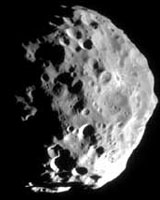
Pasadena (JPL) Jun 11, 2004 As Cassini sails toward its rendezvous with Phoebe, details on the small, dark moon are coming into view at a dizzying pace. The images shown here to the right were taken 13 hours apart on June 10, 2004, just one day prior to closest approach. There is a dramatic increase in detail between these two views. Phoebe completes one rotation about its spin axis in nine hours and 16 minutes. We are looking at opposite hemispheres in these two views. A large crater, roughly 50 kilometers (31 miles) across, is visible in the image on the left. The image on the right shows a body heavily pitted with craters of varying sizes, including very large ones, and displaying a substantial amount of variation in surface brightness. Features that appear to be cliffs may be the boundaries between large craters. Despite its exaggerated topography, Phoebe is more round than irregular in shape. Left to right, the two views were obtained at a phase, or Sun-Phoebe spacecraft angle, of 87 degrees, and from distances of 956,000 kilometers (594,000 miles) and 658,000 kilometers (409,000 miles), respectively. The image resolutions are 5.7 and 3.9 kilometers (3.5 to 2.4 miles) per pixel, respectively. To aid visibility, the images were magnified three times via linear interpolation; no contrast enhancement was performed. Phoebe is approximately 220 kilometers (137 miles) wide. On Phoebe, the spin axis points up and approximately 13 degrees to the left of the boundary between day and night. Cassini draws closer to its only flyby of this mysterious outer moon of Saturn. Closest approach to Phoebe will be at 1:56 p.m. Pacific Time on June 11. Related Links Cassini at JPL Cassini Imaging Team SpaceDaily Search SpaceDaily Subscribe To SpaceDaily Express  Cassini Spacecraft Near First Stop In Historic Saturn Tour
 Pasadena (JPL) Jun 11, 2004
The most complex interplanetary mission ever launched is about to meet one of the solar system's enigmatic moons. Cassini will fly by Phoebe, Saturn's largest outer moon, on Friday. The closest approach is at approximately 4:56 p.m. EDT. |
|
|

| The content herein, unless otherwise known to be public domain, are Copyright 1995-2006 - SpaceDaily.AFP and UPI Wire Stories are copyright Agence France-Presse and United Press International. ESA PortalReports are copyright European Space Agency. All NASA sourced material is public domain. Additionalcopyrights may apply in whole or part to other bona fide parties. Advertising does not imply endorsement,agreement or approval of any opinions, statements or information provided by SpaceDaily on any Web page published or hosted by SpaceDaily. Privacy Statement |