 |
 |
 |
 |
 |
 |
 |
 |
 |
 |

| . |  |
. |
Cyber Cowboys And Virtual Shepherds
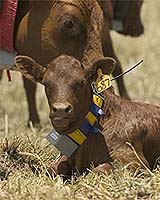
Canberra (SPX) Oct 17, 2005 Three recently patented CSIRO inventions are set to provide farmers with the ability to monitor and herd their livestock with no more effort than the push of a laptop button. The new technology targets one of the major problems faced by livestock managers - controlling free-ranging animals particularly over remote terrain. "We want to build on the ear-tags required by the National Livestock Identification System which trace animals from paddock to plate," says Dr Dave Swain of CSIRO Livestock Industries. "The goal is to introduce more functions to the tags, increase the amount of information captured and allow the data to help remote-manage those factors that are important to producers, health and safety regulators, consumers and environmentalists." In developing an appropriate device Dr Swain's team relied heavily on work by the CSIRO ICT Centre's Robotics Group on developing sensors and electronics for robots like Mantis � a remote-controlled helicopter for use primarily by the mining industry. "We already had low-cost sensors to orient an object in space," says the Centre's Principal Research Scientist, Dr Peter Corke. "These were exactly what CSIRO Livestock Industries needed. The sensors were re-engineered, repackaged and applied to a really interesting problem." The result was a livestock collar comprised of: GPS unit, inertial sensor, digital compass, transceiver and an onboard processing unit that together offer sophisticated insights into animal behaviour. "Social interactions, calf-cow relationships, herd movement and even carrying capacity of the environment can all be tracked," Dr Swain says. "This kind of information has important implications for graziers, offering improvements in food safety, disease prevention, improved breeding programs and even market access." Dr Swain and Dr Corke are also investigating the possibility that the sensors could be used to remotely control animal behaviour. "Animals learn to associate a buzzer or vibration with the delivery of an electric shock unless the animal modifies its behaviour in a certain way," Dr Swain says. "Most animals learn the association with just two or three repetitions but even individual variability in behaviour is captured and linked back to appropriate controls." Related Links CSIRO SpaceDaily Search SpaceDaily Subscribe To SpaceDaily Express  Man Beaten Bloody By New Orleans Police Pleads Not Guilty
 New Orleans, Louisiana (AFP) Oct 12, 2005
A 64-year-old man beaten bloody by New Orleans police over the weekend pleaded not guilty Wednesday to public drunkenness and resisting arrest and was released on his own recognizance. |
|
|

| The content herein, unless otherwise known to be public domain, are Copyright 1995-2006 - SpaceDaily.AFP and UPI Wire Stories are copyright Agence France-Presse and United Press International. ESA PortalReports are copyright European Space Agency. All NASA sourced material is public domain. Additionalcopyrights may apply in whole or part to other bona fide parties. Advertising does not imply endorsement,agreement or approval of any opinions, statements or information provided by SpaceDaily on any Web page published or hosted by SpaceDaily. Privacy Statement |