|
 |
 |
 |
 |
 |
 |
 |
 |
 |

| . |  |
. |
Dark Energy -- 10 Years On
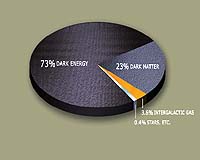
Washington DC (SPX) Dec 03, 2007 Three quarters of our universe is made up of some weird, gravitationally repulsive substance that was only discovered ten years ago - dark energy. This month in Physics World, Eric Linder and Saul Perlmutter, both at the University of California at Berkeley, reveal how little we know about dark energy and describe what advances in our knowledge of dark energy we can expect in the coming decade from a series of planned space missions. Perlmutter was the leader of one of the two separate teams of astrophysicists who concluded, from watching distant supernovae, that the cosmic expansion was accelerating and not slowing under the influence of gravity, as was previously thought. The two teams' finding confirmed just how little we know about our universe. The two teams' discovery has led to the creation of the "concordance model" of the universe, which states that 75 per cent of our universe is made up of dark energy, 21 per cent of dark matter, another substance we know little about, with only a remaining four per cent being made up of matter that we do understand. The most conventional explanation is that dark energy is some kind of "cosmological constant" that arises from empty space not being empty, but having an energy as elementary particles pop in and out of existence. Since the first evidence for the accelerating universe was made public in early 1998, astrophysicists have provided further evidence to shore up the findings and advances in the measurement methods bode well for increasing our understanding in the future. Galaxies and the cosmic background hold some significant clues. Equipment that can make a more robust comparison between galaxy patterns across the sky and investigate temperature fluctuations in the cosmic microwave background, helping trace the pattern of galaxy formation, is being made available. Methods for further observation of supernovae are expanding and improving too. Eric Linder and Saul Perlmutter write, "The field of dark energy is very young and we may have a long and exciting period of exploration ahead before it matures." The December issue also includes reporting from Robert P Crease, historian at the Brookhaven National Laboratory, US, on the difficulty of deciding who should gain credit for the discovery of the accelerating universe and comment from Lawrence M Krauss, director of the Center for Education and Research in Cosmology and Astrophysics at Case Western Reserve University, US, on the possibility that we may never be able to tell if dark energy is a cosmological constant or something more exotic still. Community Email This Article Comment On This Article Related Links Physics World Institute of Physics Stellar Chemistry, The Universe And All Within It
 An X-Ray Santa Claus In Orion
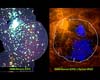 Paris, France (ESA) Dec 03, 2007
Right in time for the festive season, ESA's XMM-Newton X-ray observatory has discovered a huge cloud of high-temperature gas resting in a spectacular nearby star-forming region, shaped somewhat like the silhouette of Santa Claus. An early present for astronomers, the cloud suggests that hot gas from many star-forming regions leaks into the interstellar medium. |
|
|

| The content herein, unless otherwise known to be public domain, are Copyright 1995-2007 - SpaceDaily.AFP and UPI Wire Stories are copyright Agence France-Presse and United Press International. ESA Portal Reports are copyright European Space Agency. All NASA sourced material is public domain. Additional copyrights may apply in whole or part to other bona fide parties. Advertising does not imply endorsement,agreement or approval of any opinions, statements or information provided by SpaceDaily on any Web page published or hosted by SpaceDaily. Privacy Statement |