|
 |
 |
 |
 |
 |
 |
 |
 |
 |

| . |  |
. |
Deputy SG Talks About Future Of Air Force Medicine
Offutt NE (AFPN) May 16, 2006 Reshaping medical career fields as lean, efficient tools for providing 21st century healthcare is a priority for the Air Force deputy surgeon general. Maj. Gen. (Dr.) James G. Roudebush, who was at Offutt recently for the 2006 NOVA conference, an annual gathering of leaders from Air Force medical career fields, also spoke about practicing medicine in a deployed environment and the use of partnerships to improve healthcare at home. But the main topic of discussion at the conference, the general said, was the Air Force Smart Operations 21 program. AFSO21 is being used to streamline operations through process changes to improve efficiency and reduce waste. "The path to smart operations that the secretary and the chief of staff have put us on is both necessary and very useful," the general said. "As medics, these smart ops will make us effective in supporting both the Air Force expeditionary mission and the joint mission. Using process analysis and lean thinking will be essential in making sure that we're relevant to the mission today and tomorrow." The effects of smart operations will be visible over the coming years to both patients and medics, the general said. Patients will notice the change in the improved healthcare they will receive no matter where they are, be it as a deployed warfighter or at home in the United States. For medics, the changes will be more profound. AFSO21 will lead to processes that will allow them to better perform the mission they have been assigned, while walking unnecessary work out the door, the general said. Deployed medicine also has gone through an evolution. The general said that the war on terrorism has meant several major medical undertakings, including the stand-up of the largest theater hospital since the Vietnam War at Balad Air Base, Iraq, and the use of re-engineered aeromedical evacuation to transport wounded servicemembers from Iraq to treatment centers in Germany and the United States. "The medical mission in Iraq is truly a total force and joint mission," General Roudebush said. "We are blessed by a Reserve force that has been a wonderful partner in the aerovac arena, which allows us to recover wounded servicemembers and safely bring them home. "In some cases we are able to take recently resuscitated patients and put them in the aerovac system and actually improve their condition on the way to their next destination," he said. The general said many of the Air Force's deployed medical capabilities found use in the response to hurricanes Katrina and Rita last year. "It was Air Force medical capabilities being leveraged by our ability to rapidly deploy that put us into the New Orleans airport, which let us process and triage literally thousands of patients and move them where they needed to go in relatively short order," he said. Related Links -  Researchers Make Progress With Robotic Telesurgery
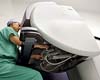 Fort Detrick MD (AFNS) May 16, 2006
However science fiction-esque it may have sounded decades ago, using robots to perform delicate surgeries is decidedly science fact today. Looking toward future decades, researchers are now trying to find ways to take robotic surgery to the battlefield. |
|
|

| The content herein, unless otherwise known to be public domain, are Copyright 1995-2006 - SpaceDaily.AFP and UPI Wire Stories are copyright Agence France-Presse and United Press International. ESA PortalReports are copyright European Space Agency. All NASA sourced material is public domain. Additionalcopyrights may apply in whole or part to other bona fide parties. Advertising does not imply endorsement,agreement or approval of any opinions, statements or information provided by SpaceDaily on any Web page published or hosted by SpaceDaily. Privacy Statement |