|
 |
 |
 |
 |
 |
 |
 |
 |
 |

| . |  |
. |
Diode Laser Could Be Vital For Safeguarding Aircraft
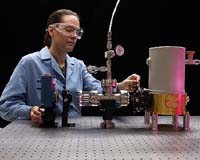
Evanston IL (SPX) Sep 01, 2006 Terrorists can strike anywhere, at any time, and aircraft, both military and civilian, are targets for heat-seeking missiles, one of many tactics in use by groups hostile to the United States. Despite their name, heat-seeking missiles actually seek a characteristic infrared light given off by hot objects. Though invisible to the human eye, tiny detectors inside the missiles can detect this infrared light and use it for guidance. To ensure the safety of aircraft, infrared countermeasure (IRCM) systems are used to confuse or blind the detectors. These systems require a high-power light source that can emit light at the correct wavelength. While various existing light sources may be able to succeed in disrupting the detectors, most are based on technology that is both bulky and expensive. Therefore, only a few military aircraft are now protected by IRCM systems. Developing a compact and inexpensive infrared light source will allow for widespread use of IRCMs, but it has proven to be a significant technical challenge. A new type of diode laser, called the quantum cascade laser (QCL), may eventually change this situation. Diode lasers are inherently compact and suitable for mass-production, which has led to their widespread and low-cost use in everyday products, including CD and DVD players. The Center for Quantum Devices (CQD) at Northwestern University, led by Manijeh Razeghi, Walter P. Murphy Professor of Electrical and Computer Engineering, has recently made great strides in laser design, material growth and laser fabrication that have greatly increased the output power and power conversion efficiency of QCLs. The center has now demonstrated individual lasers emitting at wavelengths of 3.8 and 4 microns, capable of up to 1.6 watts of continuous output power at cryogenic temperatures. These lasers have a threshold current density of less than 400 A/cm2 and a power conversion efficiency of 10 percent. With further development, the researchers at CQD hope to use laser arrays to achieve a continuous output of 10 watts or more. At this wavelength and power level, the lasers could be extremely useful for aircraft protection. Another significant breakthrough is the ability to operate these 3.8 and 4 micron lasers at room temperature. Room temperature continuous-wave operation has been demonstrated from the same devices with up to 150 milliwatts of output power. This room temperature development makes the lasers attractive for other applications, including early detection of toxic industrial chemicals, explosives and chemical warfare agents. Related Links Northwestern University  mPhase Technologies Says Its Magnetometer Could Foil Future Terrorist Acts
 Little Falls NJ (SPX) Aug 31, 2006
The recent border incursion by Hezbollah fighters into Israel and kidnapping of two soldiers on border patrol could one day be prevented by a detection device now under development, according to mPhase Technologies. |
|
|

| The content herein, unless otherwise known to be public domain, are Copyright 1995-2006 - SpaceDaily.AFP and UPI Wire Stories are copyright Agence France-Presse and United Press International. ESA PortalReports are copyright European Space Agency. All NASA sourced material is public domain. Additionalcopyrights may apply in whole or part to other bona fide parties. Advertising does not imply endorsement,agreement or approval of any opinions, statements or information provided by SpaceDaily on any Web page published or hosted by SpaceDaily. Privacy Statement |