|
 |
 |
 |
 |
 |
 |
 |
 |
 |

| . |  |
. |
Discovery Offers Clues To Origin Of Life
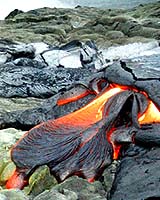
Edmonton - Apr 26, 2004 A new discovery of microbial activity in 3.5 billion-year-old volcanic rock and one of earth's earliest signs of geological existence sheds new light on the antiquity of life, says University of Alberta researchers who are part of a team that made the groundbreaking finding. "People have been looking for signs of early bacteria for the last 50 years," said Dr. Karlis Muehlenbachs, from the U of A's Faculty of Science and an author on the paper just published in the journal Science. "A variety have claimed they've seen it and subsequently been challenged as being flawed. We are suggesting that we have clear evidence of life prospering in an environment where no one else has bothered to look." The research team, also made up of Drs. Harald Furnes from the University of Bergen in Norway, Neil Banerjee from the U of A, Hubert Staudigel from the University of California and Maarten de Wit from the University of Cape Town, studied samples of pillow lava taken from the Mesoarchean Barberton Greenstone Belt in South Africa. They found mineralized tubes that were formed in the pillow lava, suggesting microbes colonized basaltic glass of the early oceanic crust, much in the same way as they do modern volcanic glass. This evidence of life in the basaltic glass on the seafloor comes in the form of textures produced by microbes as they dissolve the glass, said Banerjee. "These textures include channels or tubes produced by the microbe as it tunnels through the glass, possibly using the glass as a source of nutrients," he said. "We have also found traces of carbon, nitrogen, phosphorous and potassium-all essential to life-as well as DNA associated with the microbial alternation textures in the recent basaltic glass samples." The team then compared its $3.5 billion-year-old samples to the modern pillow lava on the seafloor using several sophisticated tests and was able to find much evidence of life. To date the microbial activity, the team compared the relationship between the tubular structures and the metamorphic mineral growth. "On the microscopic level, we see that during metamorphism, the new minerals cross cut the preserved biological features," said Muehlenbachs. "This means that the biological features pre date the metamorphism, leading to the conclusion that the microbes were attacking the glass 3.48 billion years ago-very soon after the glass chilled and lasting a few million years, perhaps until the usual geological processes buried and cooked them." Despite challenges to previous research claiming evidence of life activity, this research team is certain its evidence is solid. "In other discoveries, there has been much discussion and argument about the rock type and where it came from," said Muehlenbachs. "Everyone agrees our rock is from the sea floor-that's a sure thing. Ultimately that leads to the question of where did life start and where did it originate. And we could argue fairly effectively that maybe there is a link with the origin of life in our work." Another interesting aspect to the research, said Muehlenbachs, is that the rock type they studied is the same as on the surface of Mars. "Martian rocks would also have glass that would retain a record of life activity-we could learn a lot from them as well." Related Links University of Alberta SpaceDaily Search SpaceDaily Subscribe To SpaceDaily Express  Multinational Team of Scientists Finds Early Life in Volcanic Lava
 San Diego - Apr 26, 2004
 Scientists from the United States, Norway, Canada, and South Africa have identified what is believed to be evidence of one of Earth's earliest forms of life, a finding that could factor heavily into discussions of the origins of life. |
|
|

| The content herein, unless otherwise known to be public domain, are Copyright 1995-2006 - SpaceDaily.AFP and UPI Wire Stories are copyright Agence France-Presse and United Press International. ESA PortalReports are copyright European Space Agency. All NASA sourced material is public domain. Additionalcopyrights may apply in whole or part to other bona fide parties. Advertising does not imply endorsement,agreement or approval of any opinions, statements or information provided by SpaceDaily on any Web page published or hosted by SpaceDaily. Privacy Statement |