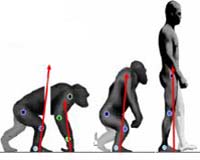
Humans walking on two legs only used one-quarter of the energy that chimpanzees who knuckle-walked on four legs did. Credit: Cary Wolinsky, Michael D. Sockol, David A. Raichlen, Harman Pontzer
Humans walking on two legs only used one-quarter of the energy that chimpanzees who knuckle-walked on four legs did. Credit: Cary Wolinsky, Michael D. Sockol, David A. Raichlen, Harman Pontzer |
Raichlen and his colleagues will publish the article, "Chimpanzee locomotor energetics and the origin of human bipedalism" in the online early edition of the Proceedings of the National Academy of Sciences (PNAS) during the week of July 16. The print issue will be published on July 24.
Bipedalism marks a critical divergence between humans and other apes and is considered a defining characteristic of human ancestors. It has been hypothesized that the reduced energy cost of walking upright would have provided evolutionary advantages by decreasing the cost of foraging.
"For decades now researchers have debated the role of energetics and the evolution of bipedalism," said Raichlen. "The big problem in the study of bipedalism was that there was little data out there."
The researches collected metabolic, kinematic and kenetic data from five chimpanzees and four adult humans walking on a treadmill. The chimpanzees were trained to walk quadrupedally and bipedally on the treadmill.
Humans walking on two legs only used one-quarter of the energy that chimpanzees who knuckle-walked on four legs did. On average, the chimpanzees used the same amount of energy using two legs as they did when they used four legs. However, there was variability among chimpanzees in how much energy they used, and this difference corresponded to their different gaits and anatomy.
"We were able to tie the energetic cost in chimps to their anatomy," said Raichlen. "We were able to show exactly why certain individuals were able to walk bipedally more cheaply than others, and we did that with biomechanical modeling."
The biomechanical modeling revealed that more energy is used with shorter steps or more active muscle mass. Indeed, the chimpanzee with the longest stride was the most efficient walking upright.
"What those results allowed us to do was to look at the fossil record and see whether fossil hominins show adaptations that would have reduced bipedal energy expenditures," said Raichlen. "We and many others have found these adaptations [such as slight increases in hindlimb extension or length] in early hominins, which tells us that energetics played a pretty large role in the evolution of bipedalism."
Community
 Evidence Found For Novel Brain Cell Communication
 Brooklyn NY (SPX) Jul 17, 2007
| The content herein, unless otherwise known to be public domain, are Copyright 1995-2007 - SpaceDaily.AFP and UPI Wire Stories are copyright Agence France-Presse and United Press International. ESA Portal Reports are copyright European Space Agency. All NASA sourced material is public domain. Additional copyrights may apply in whole or part to other bona fide parties. Advertising does not imply endorsement,agreement or approval of any opinions, statements or information provided by SpaceDaily on any Web page published or hosted by SpaceDaily. Privacy Statement |