|
 |
 |
 |
 |
 |
 |
 |
 |
 |

| . |  |
. |
Evidence Strong That It Rains On Titan
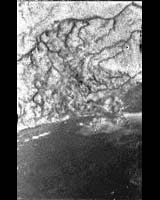
Moffett Field CA (SPX) Jul 28, 2006 NASA scientists said Thursday they have found strong evidence that liquid methane drizzles from the atmosphere of Titan onto the moon's surface. Data ESA's Huygens probe indicates there is a lower, barely visible, liquid methane-nitrogen cloud that drops rain to the surface of Titan, the team reported in the July 27 issue of Nature. The probe collected the data on Jan. 14, 2005, when it approached and landed on Titan. "The rain on Titan is just a slight drizzle, but it rains all the time, day in, day out. It makes the ground wet and muddy with liquid methane," said co-author Christopher McKay of NASA Ames Research Center in California. "This is why the Huygens probe landed with a splat," McKay added. "It landed in methane mud." On Titan, the clouds and rain are formed of liquid methane. On Earth, methane is a flammable gas, but Titan has no oxygen in its atmosphere that could support combustion. Also, temperatures on Titan are so cold - minus 300 degrees Fahrenheit (minus 149 degrees Celsius) - that the methane can form liquid. Titan's landscape includes fluvial, river-like features that may well be formed by methane rain, scientists noted. A gap separates the liquid methane cloud - the source of the rain - from a higher, upper methane ice cloud, according to the scientific study. Scientists think the downward flow of methane due to the rain is balanced by upward transport of methane gas by large-scale atmospheric circulation. Scientists also think the rain comes from thin clouds of methane. The upper clouds are methane ice, and the lower clouds are liquid and composed of a combination of methane and nitrogen. Computer models indicate these thin liquid methane clouds cover about half of Titan, even though methane abundance on the moon decreases with latitude, the team reported. "We determined that the rain on Titan is equal to about two inches (about 5 centimeters) a year," McKay said. "This is about as much rain as Death Valley (receives). The difference is on Titan, this rain is spread out evenly over the entire year." The researchers reported that erosion potential from the very light methane drizzle may be quite limited, but at least would be sufficient to wet the surface material, and may explain its generally wet character. Principal author is Tetsuya Tokano from the University of Cologne, Germany. Related Links Huygens at NASA Cassini at JPL Cassini images  How The World Watched Huygens
 Paris, France (SPX) Jul 28, 2006
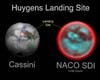
This image provides a comparison between the Huygens landing site on Titan as viewed by the Cassini Imaging Science Subsystem and the NACO/SDI instrument mounted on the 8-meter Yepun telescope of the Very Large Telescope in Chile. |
|
|

| The content herein, unless otherwise known to be public domain, are Copyright 1995-2006 - SpaceDaily.AFP and UPI Wire Stories are copyright Agence France-Presse and United Press International. ESA PortalReports are copyright European Space Agency. All NASA sourced material is public domain. Additionalcopyrights may apply in whole or part to other bona fide parties. Advertising does not imply endorsement,agreement or approval of any opinions, statements or information provided by SpaceDaily on any Web page published or hosted by SpaceDaily. Privacy Statement |