|
 |
 |
 |
 |
 |
 |
 |
 |
 |

| . |  |
. |
Galaxy Evolution Explorer Celebrates Five Years In Space
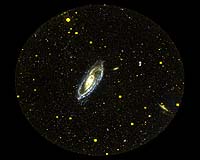
Pasadena CA (SPX) Apr 30, 2008 Since its launch five years ago, the Galaxy Evolution Explorer has photographed hundreds of millions of galaxies in ultraviolet light. M106 is one of those galaxies, and from 22 light years away, it strikes a pose in blue and gold for this new commemorative portrait. The galaxy's extended arms are the blue filaments that curve around its edge, creating its outer disk. Tints of blue in M106's arms reveal hot, young massive stars. Traces of gold toward the center show an older stellar population and indicate the presence of obscuring dust. "We see these arms in optical-light images, but they are very faint and diffuse. These structures really pop out in the ultraviolet due to the exquisite sensitivity of the detectors on the Galaxy Evolution Explorer," said Mark Seibert of the Carnegie Institution of Washington in Pasadena, Calif. From 24 million light-years away, neighboring galaxy NGC 4248 also makes a memorable appearance, sitting just right of M106. The irregular galaxy looks like a yellow smudge, with a bluish-white bar in the center. The galaxy's outer golden glow indicates a population of older stars, while the blue central region shows a younger stellar demographic. Dwarf galaxy UGC 7365 emerges at the bottom center of this image, as a faint yellow smudge directly below M106. This galaxy is not forming any new stars, and looks much smaller than M106 despite being closer to Earth, at 14 million light-years away. Over the past five years, the Galaxy Evolution Explorer has imaged half a billion objects over 27,000 square degrees of sky - equivalent to an area that would be covered by 138,000 full moons. The telescope orbits Earth every 94 minutes and travels approximately 408,470 million miles per day. Its overarching question is: how do galaxies grow and change over 10 billion years of cosmic history? "Frankly we have only begun to scratch the surface of this vast data set. Astronomers will be mining the telescope's data archive for the next decade," said Chris Martin, of the California Institute of Technology, Pasadena, Calif. He is principal investigator for the Galaxy Evolution Explorer mission, which is managed by NASA's Jet Propulsion Laboratory in Pasadena, Calif. M106, also known as NGC 4258, is located in the constellation Canes Venatici. This image is a two-color composite, where far-ultraviolet light is blue, and near-ultraviolet light is red. Community Email This Article Comment On This Article Related Links Stellar Chemistry, The Universe And All Within It
 Compact Galaxies In Early Universe Pack A Big Punch
 Baltimore MD (SPX) Apr 30, 2008
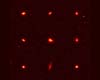
Imagine receiving an announcement touting the birth of a baby 20 inches long and weighing 180 pounds. After reading this puzzling message, you would immediately think the baby's weight was a misprint. Astronomers looking at galaxies in the universe's distant past received a similar perplexing announcement when they found nine young, compact galaxies, each weighing in at 200 billion times the mass of the Sun. |
|
|

| The content herein, unless otherwise known to be public domain, are Copyright 1995-2007 - SpaceDaily.AFP and UPI Wire Stories are copyright Agence France-Presse and United Press International. ESA Portal Reports are copyright European Space Agency. All NASA sourced material is public domain. Additional copyrights may apply in whole or part to other bona fide parties. Advertising does not imply endorsement,agreement or approval of any opinions, statements or information provided by SpaceDaily on any Web page published or hosted by SpaceDaily. Privacy Statement |