|
 |
 |
 |
 |
 |
 |
 |
 |
 |

| . |  |
. |
Global Warming Could Halt Ocean Circulation With Harmful Results
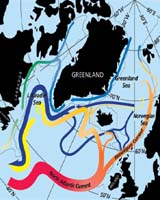
Chicago IL (SPX) Dec 08, 2005 Absent any climate policy, scientists have found a 70 percent chance of shutting down the thermohaline circulation in the North Atlantic Ocean over the next 200 years, with a 45 percent probability of this occurring in this century. The likelihood decreases with mitigation, but even the most rigorous immediate climate policy would still leave a 25 percent chance of a thermohaline collapse. "This is a dangerous, human-induced climate change," said Michael Schlesinger, a professor of atmospheric sciences at the University of Illinois at Urbana-Champaign. "The shutdown of the thermohaline circulation has been characterized as a high-consequence, low-probability event. Our analysis, including the uncertainties in the problem, indicates it is a high-consequence, high-probability event." Schlesinger will present a talk "Assessing the Risk of a Collapse of the Atlantic Thermohaline Circulation" on Dec. 8 at the United Nations Climate Control Conference in Montreal. He will discuss recent work he and his colleagues performed on simulating and understanding the thermohaline circulation in the North Atlantic Ocean. The thermohaline circulation is driven by differences in seawater density, caused by temperature and salinity. Like a great conveyor belt, the circulation pattern moves warm surface water from the southern hemisphere toward the North Pole. Between Greenland and Norway, the water cools, sinks into the deep ocean, and begins flowing back to the south. "This movement carries a tremendous amount of heat northward, and plays a vital role in maintaining the current climate," Schlesinger said. "If the thermohaline circulation shut down, the southern hemisphere would become warmer and the northern hemisphere would become colder. The heavily populated regions of eastern North America and western Europe would experience a significant shift in climate." Higher temperatures caused by global warming could add fresh water to the northern North Atlantic by increasing the precipitation and by melting nearby sea ice, mountain glaciers and the Greenland ice sheet. This influx of fresh water could reduce the surface salinity and density, leading to a shutdown of the thermohaline circulation. "We already have evidence dating back to 1965 that shows a drop in salinity around the North Atlantic," Schlesinger said. "The change is small, compared to what our model needs to shut down the thermohaline, but we could be standing at the brink of an abrupt and irreversible climate change." To analyze the problem, Schlesinger and his colleagues first used an uncoupled ocean general circulation model and a coupled atmosphere-ocean general circulation model to simulate the present-day thermohaline circulation and explore how it would behave in response to the addition of fresh water. They then used an extended, but simplified, model to represent the wide range of behavior of the thermohaline circulation. By combining the simple model with an economic model, they could estimate the likelihood of a shutdown between now and 2205, both with and without the policy intervention of a carbon tax on fossil fuels. The carbon tax started out at $10 per ton of carbon (about five cents per gallon of gasoline) and gradually increased. "We found that there is a 70 percent likelihood of a thermohaline collapse, absent any climate policy," Schlesinger said. "Although this likelihood can be reduced by the policy intervention, it still exceeds 25 percent even with maximal policy intervention." Because the risk of a thermohaline collapse is unacceptably large, Schlesinger said, "measures over and above the policy intervention of a carbon tax -- such as carbon capture and sequestration -- should be given serious consideration."
Collaborators on this research are U. of I. research programmer Bin Li, Princeton University researchers Sergey Malyshev and Jianjun Yin, University of Michigan research scientist Natasha Andronova, and Wesleyan University economics professor Gary Yohe. Related Links Illinois at Urbana-Champaign SpaceDaily Search SpaceDaily Subscribe To SpaceDaily Express  New Technology For New Exploration Of Hydrothermal Vents
 Woods Hole MA (SPX) Dec 07, 2005
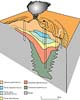
Advances in undersea imaging systems, the development of new vehicles and instruments, and improved seafloor mapping capabilities have enabled scientists to explore areas of the deep sea in unprecedented detail. One such area is the TAG hydrothermal mound in the North Atlantic Ocean, one of the largest known mineral deposits on the seafloor. |
|
|

| The content herein, unless otherwise known to be public domain, are Copyright 1995-2006 - SpaceDaily.AFP and UPI Wire Stories are copyright Agence France-Presse and United Press International. ESA PortalReports are copyright European Space Agency. All NASA sourced material is public domain. Additionalcopyrights may apply in whole or part to other bona fide parties. Advertising does not imply endorsement,agreement or approval of any opinions, statements or information provided by SpaceDaily on any Web page published or hosted by SpaceDaily. Privacy Statement |