|
 |
 |
 |
 |
 |
 |
 |
 |
 |

| . |  |
. |
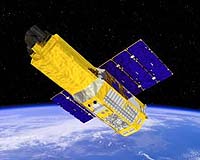
Goddard Telescopes Aboard Suzaku Spacecraft Send Back 'First Light' Images
Greenbelt MD (SPX) Sep 05, 2005 The Japan Aerospace Exploration Agency's (JAXA) Suzaku mission has seen remarkable first light images thanks to four X-Ray Telescopes (XRTs) built by NASA's Goddard Space Flight Center. The XRTs focus incoming x-rays onto the four X-Ray Spectrometer instruments onboard Suzaku, formerly known as Astro-E2. The four X-ray telescopes, together with a set of four cameras, performed flawlessly, capturing the image of an exploded star in the Small Magellanic Cloud. Supernovae are the cosmic factories of the most important elements in the Universe, and supernova remnants provide the crucial information on how they get disseminated in space. They are also spectacular objects and the ideal targets to "show off" the capabilities of the detectors. "I'm extremely pleased to see how the four telescopes performed," said team lead Dr. Peter Serlemitsos of the X-Ray Astrophysics Branch at GSFC. "Obviously it will take more time to study their performance in detail, but the first light images confirmed our expectations based on ground calibration." The four XRTs are made with foils coated with about two pounds of gold with a thickness of only 2,000 angstroms, which is about 1/200 to 1/600 the thickness of a human hair. X-rays bounce off the gold and are reflected toward the telescope detectors. The four Charge-Coupled Devices detectors that capture the X-rays bounced by the telescopes are similar to those onboard other missions, such as Chandra and XMM-Newton, although these are new and have not yet been subjected to the rigors of space. The new instruments will allow scientists to study spectra and images of extended and faint sources like supernova remnants or cluster of galaxies. It has been a bittersweet few weeks for the Suzaku team because another instrument on board, a high spectral resolution calorimeter built at GSFC, stopped functioning due to a problem with the cryogenics. The incident is still under investigation. Despite this setback, the rest of the Suzaku mission is proceeding on schedule with first light from the third set of detectors on board � two hard X-ray detectors capable of capturing the very high-energy photons � expected shortly. Related Links SpaceDaily Search SpaceDaily Subscribe To SpaceDaily Express  NSF Awards $14.2 Million to Large Synoptic Survey Telescope
 Davis CA (SPX) Sep 05, 2005
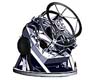
The Large Synoptic Survey Telescope has received the first year of a four-year, $14.2 million award from the National Science Foundation to design and develop a world-class, 8.4-meter telescope scheduled for completion in 2012.
--------------------------------------------------------- It's new. And it's downright terrific! Celestron's CPC Schmidt-Cassegrain telescope is the scope you've been waiting for! It offers new alignment technology, advanced engineering, and bold new design at a new, low price! In fact, Celestron's Professional Computerized (CPC) scope with revolutionary SkyAlign Alignment Technology redefines everything that amateur astronomers are looking for. It offers quick and simple alignment, GPS technology, unsurpassed optical quality, ease of use, advanced ergonomics, enhanced computerization and, most important, affordability. Want to view M-31 tonight? One button takes you there!
Shop for telescopes online at Telescopes.com! today!
|
|
|

| The content herein, unless otherwise known to be public domain, are Copyright 1995-2006 - SpaceDaily.AFP and UPI Wire Stories are copyright Agence France-Presse and United Press International. ESA PortalReports are copyright European Space Agency. All NASA sourced material is public domain. Additionalcopyrights may apply in whole or part to other bona fide parties. Advertising does not imply endorsement,agreement or approval of any opinions, statements or information provided by SpaceDaily on any Web page published or hosted by SpaceDaily. Privacy Statement |