
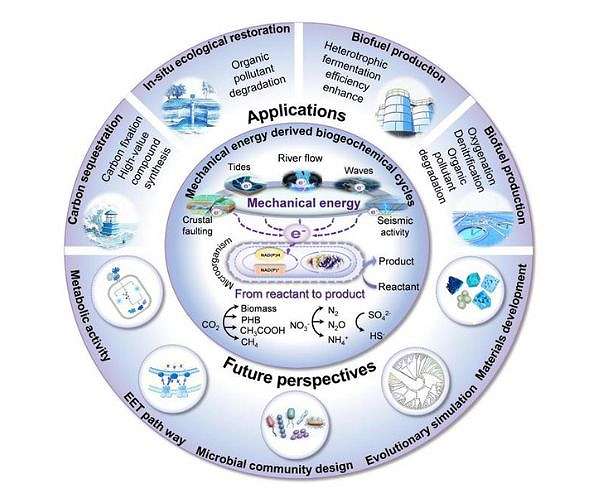
Life on Earth has traditionally been viewed as running on two main energy sources, sunlight captured by photosynthesis and chemical energy derived from reactions such as microbes feeding on reduced compounds in soils, sediments, and oceans.
A new review introduces a third, largely overlooked energy source that may help drive global biogeochemical cycles, mechanical force converted into usable energy in natural environments.
In a paper published in Environmental and Biogeochemical Processes, researchers outline a framework they call mechano biogeochemistry, which focuses on how natural mechanical forces can be transformed into electrical energy through the piezoelectric effect.
Mechanical forces from flowing rivers, ocean waves, tides, sediment movement, and even seismic activity can deform piezoelectric minerals and generate electric charges that become available to surrounding microorganisms.
Certain minerals, including quartz, barium titanate, and zinc oxide, produce electric charges when they are squeezed, bent, or vibrated, creating a continuous but diffuse source of electrons in mechanically active settings.
Electroactive microorganisms can capture these electrons through specialized electron transfer systems located on their cell surfaces, allowing them to use this mechanical derived electrical energy to fuel metabolism.
According to corresponding author Shungui Zhou, microbial energetics has largely been explained through light and chemical energy, but mechanical energy is widespread in the environment and may act as a hidden driver of microbial processes that control global element cycles.
The authors describe a two step energy pathway in which mechanical deformation of piezoelectric materials first generates electrons, followed by microbial uptake of these electrons to support growth and drive redox reactions, even where sunlight or conventional chemical fuels are scarce.
Laboratory studies have begun to support this concept, with experiments showing that mechanically stimulated piezoelectric materials can sustain microbial carbon fixation, nitrogen transformations, sulfate reduction, methane production, and degradation of various pollutants.
In some experimental systems, microbes convert carbon dioxide into biomass or bioplastics with mechanical energy functioning as the primary energy input, highlighting a potential route for carbon capture driven by environmental motion.
Co author Lingyu Meng notes that this mechanism helps explain how microbial life can persist in extremely energy limited environments such as deep subsurface sediments or the deep ocean, where mechanical forces still operate despite the absence of light.
Mechanical energy from processes such as sediment compaction, fluid movement, and tectonic strain can penetrate deep into Earths crust, potentially providing small but persistent amounts of energy to sustain microbial ecosystems over long timescales.
The mechano biogeochemistry framework also offers new perspectives on early Earth, when mechanical processes like sediment grinding, wave action, and tectonic activity were already active before oxygen rich atmospheres and extensive photosynthesis had developed.
These processes may have generated reactive molecules and electrical gradients that supported early microbial metabolisms, providing transitional steps toward the more complex metabolic pathways that dominate modern ecosystems.
The authors suggest that recognizing mechanical energy as a contributor to microbial energetics could refine models of Earths biogeochemical cycles by accounting for energy flows that are not captured by light or chemical based frameworks.
Beyond its implications for basic science, mechano biogeochemistry may inspire new technologies that harness mechanical motion for low energy environmental and industrial applications.
Potential uses include wastewater treatment systems where water flow or structural vibration replaces energy intensive aeration while still supporting microbial communities that remove contaminants.
Mechanical energy driven systems could also play a role in carbon capture and sustainable biomanufacturing, for example by coupling piezoelectric materials with electroactive microbes that convert carbon dioxide into useful products without large external power inputs.
The authors emphasize that mechano biogeochemistry does not displace established theories of microbial energetics, but instead complements them by addressing conditions where light and conventional chemical energy sources are limited or intermittent.
Lead author Zhou argues that integrating physics, geology, materials science, and microbiology into a unified view of Earth systems will clarify how mechanical energy fits alongside other energy sources in sustaining life.
Mechanical energy has always been present in Earths dynamic environments, from pounding surf to shifting tectonic plates, and the authors contend that its biological significance is only now coming into focus.
Significant challenges remain, including quantifying how much mechanical energy contributes to natural ecosystems and translating laboratory findings into realistic field scale estimates.
Researchers will need new methods to measure in situ electron fluxes from piezoelectric materials and to distinguish mechanical energy driven processes from those powered by other energy sources.
Despite these uncertainties, the authors propose that acknowledging this hidden energy pathway could reshape understanding of lifes resilience on Earth, particularly in extreme environments.
The concept may also extend to astrobiology, as mechanical energy generated by tectonics, impacts, or cryovolcanism on other planetary bodies could help sustain microbial life where sunlight is limited and traditional chemical fuels are scarce.
Research Report:The hidden mechanistic hand: the mechanical force that drives global biogeochemical cycles
