|
 |
 |
 |
 |
 |
 |
 |
 |
 |

| . |  |
. |
Hong Kong Inches Toward Democracy
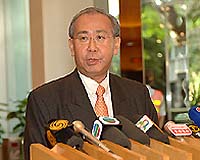
Hong Kong (UPI) Oct 20, 2005 Hong Kong's government leaders, operating in the narrow chasm between a rock and a hard place, have put forward a proposal intended to inch the territory closer to democracy. In a report issued Wednesday, the government's constitutional development task force made public its plan to tweak the electoral system and broaden the base of directly and indirectly elected legislators in the next round of elections, set for 2008. Coming just as the economy was rebounding and people were settling into their usual frenetic lifestyle, leaving their political future to simmer on the back burner, the report has sparked new waves of controversy. Since the Chinese National People's Congress Standing Committee ruled against allowing direct elections for Hong Kong's chief executive in 2007 and legislature in 2008, the task force has been seeking ways to move toward the eventual goal of universal suffrage at a pace quick enough to satisfy an increasingly politicized public, and slow enough not to alarm the increasingly involved central government in Beijing. In that ruling, the NPC set certain parameters limiting Hong Kong's options, such as the requirement the ratio between directly and indirectly elected legislators must remain at 50/50. The government maneuvered around that by proposing the addition of 10 new seats in the legislature, five of each type, and defining the five new "functional constituencies," or interest groups, so broadly that 3 million people will be able to vote in them. Most of the existing functional constituencies are comprised of small groups of business and professional interests, each empowered to elect one legislator in the 60-member chamber. Chief Secretary Rafael Hui, explaining the plan to foreign journalists Thursday, admitted, "As far as universal suffrage is concerned, it's not a full glass." But he said the reforms had the best chance of gaining the required two-thirds legislative approval, as well as the NPC's endorsement, to enact them into law. He acknowledged, however, that was likely to be a tough task. Pro-democracy legislators, who occupy 25 seats in the legislature, slammed the proposed reforms and called for a public march against them on Dec. 4. Democratic Party representatives complained there was no timetable for universal suffrage, or road map as to how that would eventually be achieved. They also protested the government's plan to increase the size of the Election Committee, which selects the chief executive, by including both elected and appointed district councilors. About 80 percent of district councilors are directly elected, but the 20 percent that are government appointees would give the incumbent, or his chosen successor, an unfair advantage. Hui explained the inclusion of the councilors, who currently perform grassroots tasks at the district level, was intended to develop a political culture and cultivate talented leaders among the people by creating an upwardly mobile political structure. Unless they are able to win over at least five democrats, the carefully crafted scheme of Chief Executive Donald Tsang and his team will go nowhere and the current election procedures will remain in place until 2012. "I do not really have a Plan B as of today," Hui acknowledged. Apparently he is hoping democrats will decide that miniscule progress is better than none, and be willing to take a longer-term view of the democratic process. Ironically, on the same day the Hong Kong government issued its report, the central government in Beijing issued its first policy paper on political reform, titled "Building of Political Democracy in China." Despite its promising title, the 74-page paper is heavily laced with outdated rhetoric, stressing the supremacy of the Communist Party and the "Marxist theory of democracy," which relies on the "people's democratic dictatorship." The paper claims the Chinese people's democratic rights are increasing, and says, "Major aspects of China's politics, economics, culture and social life are now within the purview of the rule of law." It goes on to outline some of the country's remaining problems, acknowledging that "the democratic system is not yet perfect," that enacted laws "are sometimes not fully observed or enforced," and that "bureaucracy and corruption still exist and spread in some departments and localities." The document promises these problems will be overcome, without offering any details as to how this is to be done. Comparing the two plans for the advancement of democracy, even the democrats might find the Hong Kong government's slow but steady approach taking on a new appeal. Reflecting on the fact that the ultimate decision-making power over the Hong Kong people lies in the hands of the authors of the Beijing policy paper might dampen the aspirations of the staunchest Hong Kong democrat. Perhaps that was one of its intended effects. Related Links SpaceDaily Search SpaceDaily Subscribe To SpaceDaily Express  Analysis: Germany's New Greens
 Kehl Am Rhein, Germany (UPI) Sep 28, 2005
Voters booted them out of Germany's government, their poster boy retired and neo-conservatives and leftists surpassed them in the country's federal elections: The world's most successful Green Party is heading into parliamentary opposition and a new era. |
|
|

| The content herein, unless otherwise known to be public domain, are Copyright 1995-2006 - SpaceDaily.AFP and UPI Wire Stories are copyright Agence France-Presse and United Press International. ESA PortalReports are copyright European Space Agency. All NASA sourced material is public domain. Additionalcopyrights may apply in whole or part to other bona fide parties. Advertising does not imply endorsement,agreement or approval of any opinions, statements or information provided by SpaceDaily on any Web page published or hosted by SpaceDaily. Privacy Statement |