|
 |
 |
 |
 |
 |
 |
 |
 |
 |

| . |  |
. |
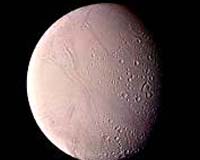
Hot Spot On Enceladus Causes Plumes
San Francisco CA (SPX) Dec 18, 2007 Enceladus, the tiny satellite of Saturn, is colder than ice, but data gathered by the Cassini-Huygens Mission to Saturn and Titan has detected a hot spot that could mean there is life in the old moon after all. In fact, for researchers of the outer planets, Enceladus is so intellectually hot, it's smokin'. The heat being generated on the moon's south pole at a hot spot is enough to eject plumes of ice and vapor above Enceladus. These plumes, according to William B. McKinnon, Ph.D., professor of earth and planetary sciences in Arts and Sciences at Washington University in St. Louis, are this moon's most intriguing feature. "The plume particles are like smoke, ice smoke," McKinnon said. "If you were standing on Enceladus' surface you wouldn't even be able to see the plumes. The particles are just larger than the wavelength of light, about one-thousandths of a millimeter. Most icy bodies of this size are geologically inert, but this is a clear indication of geological activity. Cassini has found active venting of water vapor. This leads to scientifically intriguing speculations and questions." One is: Is this active ice volcanism on Enceladus? If so, is it due to ice sublimating, in the manner of a comet, or to a different mechanism, like boiling water, as in Old Faithful at Yellowstone? The biggest question: If there is water on Enceladus, is there life? "I don't think so," McKinnon said. "The strongest piece of evidence against that is measurements made from Earth of the plume don't show any sodium. If the source of the plumes were fresh water like on Earth, the plumes would contain enough detectable sodium. Fresh water flows through rocks and on streambeds, and so it picks up bits of mineral chemistry. The emerging view is that there's not obvious evidence for a subterranean ocean in contact with rock, no boiling or venting." McKinnon said that the leading model for the cause of the plumes on Enceladus is that the moon's tides cause its crust to ratchet or rub back and forth in a set of faults near the south pole. This action generates just enough heat to vaporize the ice that makes the plumes. Cassini, which has been passing through the plumes of Enceladus, makes its next pass in March of 2008. It will go deeper into the plume and take more pictures of the moon's features, the venting area in the infrared, impact craters, cracks and fissures, and make better measurements of gases and vapors. McKinnon presented "Cold Fire: The Geology and Geophysics of Enceladus," Dec. 10, 2007, at the Fall Meeting of the American Geophysical Union in San Francisco. The mythological Enceladus is buried beneath Mount Etna and is responsible for the mountain's tremors and volcanism. The moon Enceladus is only 500 kilometers wide - roughly 300 miles wide, the distance between St. Louis and Chicago, and quite round for such a small body. Data from Cassini has revealed a rock-rich body, 55 to 60 percent rock by mass, with a surface of nearly pure water ice. The temperature at the poles is some -220 degrees Celsius (C), but the hot spot is at least 100 degrees warmer. Enceladus is in a special relationship called dynamical resonance with another one of Saturn's moons, Dione. Every time Dione, in an exterior orbit around Saturn, circles Saturn, Enceladus goes around exactly twice. This resonance keeps Enceladus' orbit tidally pumped, maintaining an eccentric path that leads to a continuous squeezing under Saturn's gravity field. This process makes a small part of the planet hot, relatively, for an icy satellite. It's the same mechanism that runs the tremendously hot silicate volcanism of Io and activates Europa, maintaining its ocean. Lo and Europa are two of Jupiter's moons. "You only have to get so hot to make ice active," McKinnon said. "It doesn't have to get tremendously hot like it does on Lo. Ice volcanism requires an order of magnitude less energy for things to work out pretty well. The hot spots are -100 degrees C or possibly 'warmer'; the area around it is more than twice as cold. We still can't say how truly 'hot' the hot spots are. We'll probably learn this in March." Community Email This Article Comment On This Article Related Links Washington University in St. Louis Explore The Ring World of Saturn and her moons Jupiter and its Moons The million outer planets of a star called Sol News Flash at Mercury
 Cassini Captures Best View Yet Of Saturn's Ring Currents
 Baltimore MD (SPX) Dec 14, 2007
Scientists have gotten their best "look" ever at the invisible ring of energetic ions trapped in Saturn's giant magnetic field, finding that it is asymmetric and dynamic, unlike similar rings that appear around Earth. |
|
|

| The content herein, unless otherwise known to be public domain, are Copyright 1995-2007 - SpaceDaily.AFP and UPI Wire Stories are copyright Agence France-Presse and United Press International. ESA Portal Reports are copyright European Space Agency. All NASA sourced material is public domain. Additional copyrights may apply in whole or part to other bona fide parties. Advertising does not imply endorsement,agreement or approval of any opinions, statements or information provided by SpaceDaily on any Web page published or hosted by SpaceDaily. Privacy Statement |