|
 |
 |
 |
 |
 |
 |
 |
 |
 |

| . |  |
. |
Hubble Probes Layer-Cake Structure Of Extra Solar Gas Giant Atmosphere
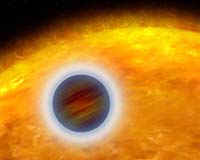
Baltimore MD (SPX) Feb 01, 2007 The powerful vision of NASA's Hubble Space Telescope has allowed astronomers to study for the first time the layer-cake structure of the atmosphere of a planet orbiting another star. Hubble discovered a dense upper layer of hot hydrogen gas where the super-hot planet's atmosphere is bleeding off into space. The planet, designated HD 209458b, is unlike any world in our solar system. It orbits so close to its star and gets so hot that its gas is streaming into space, making the planet appear to have a comet-like tail. This new research reveals the layer in the planet's upper atmosphere where the gas becomes so heated it escapes, like steam rising from a boiler. "The layer we studied is actually a transition zone where the temperature skyrockets from about 1,340 degrees Fahrenheit (1,000 Kelvin) to about 25,540 degrees (15,000 Kelvin), which is hotter than the Sun," said Gilda Ballester of the University of Arizona in Tucson, leader of the research team. "With this detection we see the details of how a planet loses its atmosphere." The findings by Ballester, David K. Sing of the University of Arizona and the Institut d'Astrophysique de Paris, and Floyd Herbert of the University of Arizona will appear Feb. 1 in a letter to the journal Nature. The Hubble data show how Intense ultraviolet radiation from the host star heats the gas in the upper atmosphere, inflating the atmosphere like a balloon. The gas is so hot that it moves very fast and escapes the planet's gravitational pull at a rate of 10,000 tons a second, more than three times the rate of water flowing over Niagara Falls. The planet, however, will not wither away any time soon. Astronomers estimate its lifetime is more than 5 billion years. The scorched planet is a big puffy version of Jupiter. In fact, it is called a "hot Jupiter," a large gaseous planet orbiting very close to its parent star. Jupiter might even look like HD 209458b if it were close to the Sun, Ballester said. The planet completes an orbit around its star every 3.5 days. It orbits 4. 7 million miles from its host, 20 times closer than the Earth is to the Sun. By comparison, Mercury, the closest planet to our Sun, is 10 times farther away from the Sun than HD 209458b is from its star. Unlike HD 209458b, Mercury is a small ball of iron with a rocky crust. "This planet's extreme atmosphere could yield insights into the atmospheres of other hot Jupiters," Ballester said. Although HD 209458b does not have a twin in our solar system, it has plenty of relative beyond our solar system. About 10 to 15 percent of the more than 200 known extrasolar planets are hot Jupiters. A recent Hubble survey netted 16 hot Jupiter candidates in the central region of our Milky Way Galaxy, suggesting that there may be billions of these gas-giant star huggers in our galaxy. HD 209458b is one of the most intensely studied extrasolar planets because it is one of the few known alien worlds that can be seen passing in front of, or transiting, its star, causing the star to dim slightly. In fact, the gas giant is the first such alien world discovered to transit its star. HD 209458b is 150 light-years from Earth in the constellation Pegasus. The planet's transits allow astronomers to analyze the structure and chemical makeup of the gas giant's atmosphere by sampling the starlight that passes through it. The effect is similar to finding fingerprints on a window by watching how sunlight filters through the glass. Previous Hubble observations revealed oxygen, carbon, and sodium in the planet's atmosphere, as well as a huge hydrogen upper atmosphere with a comet-like tail. These landmark studies provided the first detection of the chemical makeup of an extrasolar planet's atmosphere. Additional observations by NASA's Spitzer Space Telescope captured the infrared glow from the planet's hot atmosphere. The new study by Ballester and her team is based on an analysis of archival observations made in 2003 with Hubble's Space Telescope Imaging Spectrograph by David Charbonneau of the Harvard-Smithsonian Center for Astrophysics in Cambridge, Mass. Ballester's team analyzed spectra from hot hydrogen atoms in the planet's upper atmosphere, a region not studied by Charbonneau's group. Related Links Planet HD 209458b at Hubble Beyond Sol  Strongest Winds On Earth Would Not Even Be A Breeze On These Planets
 Seattle WA (SPX) Jan 11, 2007
Earth's inhabitants are used to temperatures that vary, sometimes greatly, between day and night. New measurements for three planets outside our solar system indicate their temperatures remain fairly constant - and blazing hot - from day to night, even though it is likely one side of each planet always faces its sun and the other is in permanent darkness. |
|
|

| The content herein, unless otherwise known to be public domain, are Copyright 1995-2006 - SpaceDaily.AFP and UPI Wire Stories are copyright Agence France-Presse and United Press International. ESA PortalReports are copyright European Space Agency. All NASA sourced material is public domain. Additionalcopyrights may apply in whole or part to other bona fide parties. Advertising does not imply endorsement,agreement or approval of any opinions, statements or information provided by SpaceDaily on any Web page published or hosted by SpaceDaily. Privacy Statement |