|
 |
 |
 |
 |
 |
 |
 |
 |
 |

| . |  |
. |
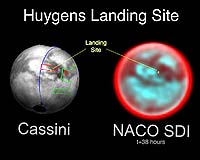
Huygens Landing Site To Be Named After Hubert Curien
Paris, France (ESA) Mar 06, 2007 As of 14 March, an epic space mission and one of the founding fathers of the European space endeavour will be forever linked. ESA, the international Committee for Space Research (COSPAR) and NASA have decided to honour Professor Hubert Curien's contribution to European space by naming the Huygens landing site on Saturn's largest moon, Titan, after him. The naming ceremony for the Huygens landing site, which will be known as the "Hubert Curien Memorial Station", will be held at ESA's Headquarters on 14 March, in the presence of ESA Council delegates and of Professor Curien's wife, Mrs Perrine Curien, and one of their sons. Media interested in attending are invited to submit the reply form below. Huygens' landing on Saturn's largest moon in January 2005 represented one of the greatest successes achieved by humankind in the history of space exploration. The part played by ESA, in cooperation with NASA and the Italian Space Agency (ASI), was made possible thanks to the commitment of a man who, for several decades, worked to promote and strengthen the role of scientific research in his home country - France - and in Europe. Among his numerous responsibilities, Hubert Curien was French Minister of Research and Space under four Prime Ministers. As Chairman of the ESA Council from 1981 to 1984, Professor Curien played a crucial part in setting up ESA's former long-term science programme, "Horizon 2000", which included the Huygens mission among its projects. Professor Roger Bonnet, current President of COSPAR, and former ESA Director of Science (1983-2001), commented: "Curien's diplomatic skills were hugely influential in bringing about the birth of European space science. In 1985, his support was pivotal when the European ministers had to decide how to build a solid space science programme and ensure that it would be financially sustainable in the long term." "ESA's present science programme, Cosmic Vision, draws on the heritage left by Hubert Curien", said Professor David Southwood, ESA's current Director of Science. "He encouraged cooperation between nations in the belief that space research is fundamental to the progress and welfare of a knowledge-based society like ours. He also promoted the concept of long-term planning", he continued. "It would seem almost inconceivable today to initiate any space venture without such pillar concepts in mind". "The role played by Hubert Curien in creating a European space dimension, with all its various facets, has been absolutely essential", said Jean-Jacques Dordain, ESA Director General. "Curien was one of the fathers of the Ariane Programme, which provided Europe with independent access to space, and one of those who, in the late seventies, persuaded other countries to join ESA by creating the 'fair return' system for industrial contracts." Dordain continued, "This exceptional man of vision was appreciated by all for his scientific competence and his outstanding human, political and diplomatic abilities. It is therefore a true honour for us to pay tribute to his memory by linking his name forever to this very significant place on the surface of an alien world that, also thanks to him, we were able to reach." Email This Article
Related Links  Boulder CO (SPX) Mar 02, 2007
NASA's Cassini spacecraft has captured never-before-seen views of Saturn from perspectives high above and below the planet's rings. Over the last several months, the spacecraft has climbed to higher and higher inclinations, providing its cameras with glimpses of the planet and rings that have scientists gushing. |
|
|

| The content herein, unless otherwise known to be public domain, are Copyright 1995-2006 - SpaceDaily.AFP and UPI Wire Stories are copyright Agence France-Presse and United Press International. ESA PortalReports are copyright European Space Agency. All NASA sourced material is public domain. Additionalcopyrights may apply in whole or part to other bona fide parties. Advertising does not imply endorsement,agreement or approval of any opinions, statements or information provided by SpaceDaily on any Web page published or hosted by SpaceDaily. Privacy Statement |