|
 |
 |
 |
 |
 |
 |
 |
 |
 |

| . |  |
. |
Icebound Antarctic Telescope Delivers First Neutrino Sky Map
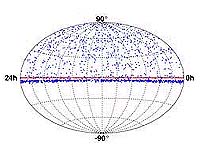
Sydney - Jul 16, 2003 A novel telescope that uses the Antarctic ice sheet as its window to the cosmos has produced the first map of the high-energy neutrino sky. The map, unveiled for astronomers Tueday in Sydney at a meeting of the International Astronomical Union, provides astronomers with their first tantalizing glimpse of very high-energy neutrinos, ghostly particles that are believed to emanate from some of the most violent events in the universe -- crashing black holes, gamma ray bursts, and the violent cores of distant galaxies. "This is the first data with a neutrino telescope with realistic discovery potential," says Francis Halzen, a University of Wisconsin-Madison professor of physics, of the map compiled using AMANDA II, a one-of-a-kind telescope built with support from the National Science Foundation (NSF) and composed of arrays of light-gathering detectors buried in ice 1.5 kilometers beneath the South Pole. "To date, this is the most sensitive way ever to look at the high-energy neutrino sky," he says. The ability to detect high-energy neutrinos and trace them back to their points of origin remains one of the most important quests of modern astrophysics. Because cosmic neutrinos are invisible, uncharged and have almost no mass, they are next to impossible to detect. Unlike photons, the particles that make up visible light, and other kinds of radiation, neutrinos can pass unimpeded through planets, stars, the vast magnetic fields of interstellar space and even entire galaxies. That quality -- which makes them very hard to detect -- is also their greatest asset because the information they harbor about cosmologically distant and otherwise unobservable events remains intact. The map produced by AMANDA II is preliminary, Halzen emphasizes, and represents only one year of data gathered by the icebound telescope. Using two more years of data already harvested with AMANDA II, Halzen and his colleagues will next define the structure of the sky map and sort out potential signals from statistical fluctuations in the present map to confirm or disprove them. The significance of the map, according to Halzen, is that it proves the detector works. "It establishes the performance of the technology," he says, "and it shows that we have reached the same sensitivity as telescopes used to detect gamma rays in the same high-energy region" of the electromagnetic spectrum. Roughly equal signals are expected from objects that accelerate cosmic rays, whose origins remain unknown nearly a century after their discovery. Sunk deep into the Antarctic ice, the AMANDA II (Antarctic Muon and Neutrino Detector Array) Telescope is designed to look not up, but down, through the Earth to the sky in the Northern Hemisphere. The telescope consists of 677 glass optical modules, each the size of a bowling ball, arrayed on 19 cables set deep in the ice with the help of high-pressure hot-water drills. The array transforms a cylinder of ice 500 meters in height and 120 meters in diameter into a particle detector. The glass modules work like light bulbs in reverse. They detect and capture faint and fleeting streaks of light created when, on occasion, neutrinos crash into ice atoms inside or near the detector. The subatomic wrecks create muons, another species of subatomic particle that, conveniently, leaves an ephemeral wake of blue light in the deep Antarctic ice. The streak of light matches the path of the neutrino and points back to its point of origin. Because it provides the first glimpse of the high-energy neutrino sky, the map will be of intense interest to astronomers because, says Halzen," we still have no clue how cosmic rays are accelerated or where they come from." The fact that AMANDA II has now identified neutrinos up to one hundred times the energy of the particles produced by the most powerful earthbound accelerators raises the prospect that some of them may be kick-started on their long journeys by some of the most supremely energetic events in the cosmos. The ability to routinely detect high-energy neutrinos will provide astronomers not only with a lens to study such bizarre phenomena as colliding black holes, but with a means to gain direct access to unedited information from events that occurred hundreds of millions or billions of light years away and eons ago. "This map could hold the first evidence of a cosmic accelerator," Halzen says. "But we are not there yet." The hunt for sources of cosmic neutrinos will get a boost as the AMANDA II Telescope grows in size as new strings of detectors are added. Plans call for the telescope to grow to a cubic kilometer of instrumented ice. The new telescope, to be known as IceCube, will make scouring the skies for cosmic neutrino sources highly efficient. "We will be sensitive to the most pessimistic theoretical predictions," Halzen says. "Remember, we are looking for sources, and even if we discover something now, our sensitivity is such that we would see, at best, on the order of 10 neutrinos a year. That's not good enough." Related Links Physics at Wisconsin-Madison SpaceDaily Search SpaceDaily Subscribe To SpaceDaily Express  Actel's RTSX-S FPGAs Selected for Herschel and Planck Buses
 Sunnyvale - Jul 16, 2003
Actel Corporation announced today that its RTSX-S radiation-tolerant field-programmable gate arrays (FPGAs) have been selected for extensive use on the Herschel and Planck space probes, which are scheduled for launch by the European Space Agency (ESA) in 2007. The Herschel and Planck probes will study infrared radiation and cosmic background radiation, respectively.
--------------------------------------------------------- It's new. And it's downright terrific! Celestron's CPC Schmidt-Cassegrain telescope is the scope you've been waiting for! It offers new alignment technology, advanced engineering, and bold new design at a new, low price! In fact, Celestron's Professional Computerized (CPC) scope with revolutionary SkyAlign Alignment Technology redefines everything that amateur astronomers are looking for. It offers quick and simple alignment, GPS technology, unsurpassed optical quality, ease of use, advanced ergonomics, enhanced computerization and, most important, affordability. Want to view M-31 tonight? One button takes you there!
Shop for telescopes online at Telescopes.com! today!
|
|
|

| The content herein, unless otherwise known to be public domain, are Copyright 1995-2006 - SpaceDaily.AFP and UPI Wire Stories are copyright Agence France-Presse and United Press International. ESA PortalReports are copyright European Space Agency. All NASA sourced material is public domain. Additionalcopyrights may apply in whole or part to other bona fide parties. Advertising does not imply endorsement,agreement or approval of any opinions, statements or information provided by SpaceDaily on any Web page published or hosted by SpaceDaily. Privacy Statement |