|
 |
 |
 |
 |
 |
 |
 |
 |
 |

| . |  |
. |
Implantable Chips Bear Promise, But Privacy Standards Needed
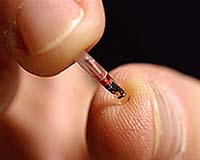
Boston MA (SPX) Jul 28, 2005 Radio frequency identification (RFID) chips implanted into human beings hold the promise of improving patient care, particularly in emergency settings, but only after privacy questions are addressed, according to a Beth Israel Deaconess Medical Center (BIDMC) physician who has a chip implanted in his arm. Writing in the July 28 edition of the New England Journal of Medicine, John Halamka, MD, chief information officer at BIDMC and Harvard Medical School and an emergency room physician, says the chip implanted in his upper right arm would allow anyone with a handheld RFID reader to scan his arm and obtain his 16-digit medical identifier. The chip, which consists of several small components encased in an unbreakable glass capsule, was implanted in his arm in December 2004 with only a local anesthetic. Any authorized health care worker can visit a secure web site hosted by the chip manufacturer and retrieve information about his identity, and that of his primary care physician, who could provide medical history details. Recalling his experience as an emergency medicine resident who could spend hours trying to determine the identify of John or Jane Doe patient, Halamka believes properly encrypted technology could prove to be a boon in helping to avoid unwanted medical interventions. "For patients with Alzheimer's disease who wander away from home, an identifier that enables caregivers to identify non-verbal or confused patients and determine their health care preferences could be very desirable," he says. But a number of significant legal, ethical and technological hurdles need to be overcome first. "Since my chip contains only my medical identifier, unauthorized reading would not disclose health information," says Halamka. "But nothing is simple," noting current technology and lack of specific privacy policy could enable spammers to track him in a manner similar to computer "spyware" that infests computers after visits to certain Internet sites. There are significant ethical questions about inserting chips in patients incapable of proving informed consent. Technology "hackers" continue to be one step ahead of developers and have shown the ability to break the encryption of existing chips used to purchase gasoline and provide automobile security. And the technology is not cheap: each chips costs $200 and a reader costs $650, raising the question of whether it is a practical investment for caregivers. While Halamka reports the chip has resulted in no discomfort, even as he has maintained an active lifestyle that has included extremes of temperature, wind and water while rock and ice climbing. If he wishes to upgrade the chip, it would require minor surgery. Otherwise, it is expected to last at least 10 years, can safely undergo magnetic resonance imaging and passes through airport security systems without incident. But one of the greatest potential hurdles to widespread adoption may be psychological. "It is clear there are philosophical consequences to having a lifelong implanted identifier. Friends and associates have commented that I am now 'marked' and lost my anonymity. "Several colleagues find the notice of a device implanted under the skins to be dehumanizing. I have not investigated these or other moral, religious or political implications. "On the basis or my unscientific study with a sample of one, I conclude that there may be appropriate uses, that there are privacy concerns that must be accepted by the implantee and that we need to establish standards that permit seamless, secure access to information," he says. Related Links Beth Israel Deaconess Medical Center SpaceDaily Search SpaceDaily Subscribe To SpaceDaily Express  Fundamental Limitation To Quantum Computers
 Leiden, The Netherlands (SPX) Jul 08, 2005
Quantum computers that store information in so-called quantum bits (or qubits) will be confronted with a fundamental limitation. |
|
|

| The content herein, unless otherwise known to be public domain, are Copyright 1995-2006 - SpaceDaily.AFP and UPI Wire Stories are copyright Agence France-Presse and United Press International. ESA PortalReports are copyright European Space Agency. All NASA sourced material is public domain. Additionalcopyrights may apply in whole or part to other bona fide parties. Advertising does not imply endorsement,agreement or approval of any opinions, statements or information provided by SpaceDaily on any Web page published or hosted by SpaceDaily. Privacy Statement |