|
 |
 |
 |
 |
 |
 |
 |
 |
 |

| . |  |
. |
India Signs With New Skies For Multi-Transponder Agreement
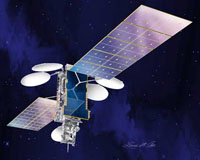
Delhi (SPX) Apr 29, 2004 New Skies Satellites and Indian Space Research Organization have signed an agreement for multiple high-powered 36 Mhz Ku-band transponders on the NSS-6 satellite. The capacity will support the launch of the world's largest free-to-air DTH service for Doordarshan, India's national broadcaster. The DTH service, expected to begin in June, will provide an initial bouquet of 30 free channels, 15 from Doordarshan and 15 from private broadcasters, as well as 20 radio channels throughout India. Additionally, one of the transponders is expected to be used for digital satellite newsgathering. "It is an honor for us to be associated with such a prestigious organization as ISRO to support Doordarshan's entry into DTH services," said Dan Goldberg, chief executive officer of New Skies. "With Doordarshan's reputation for high quality programming and their broad base of viewers, this agreement is sure to make NSS-6 a prime spot for DTH throughout the Indian subcontinent." New Skies continues to increase its market share in the India, Middle East and Africa (IMEA) region. Revenues from this region have almost tripled over the past three years from $14.2 million in 2000 to $46.0 million in 2003, and its importance as a percentage of total revenues has increased from 7 percent to 21 percent over the same period. New Skies meets the requirements of broadcasters, carriers, corporations, ISPs and government users in the IMEA region with its NSS-6, NSS-703 and NSS-7 satellites. From its prime orbital position at 95 degrees east longitude, NSS-6 covers two-thirds of the world's population - India, Pakistan, Afghanistan, Nepal, Bhutan, Bangladesh, Sri Lanka and parts of Myanmar, as well as the rest of Asia, southern Africa, the Middle East, Australia and a number of the Pacific Islands - with six high-performance Ku-band beams that can deliver direct-to-home power and performance. In addition, the satellite was designed with an eye towards the future, incorporating high-power Ka-band uplink beams over key Asian markets, making NSS-6 ideal for broadband and other emerging applications using very small and highly portable uplink equipment. Related Links New Skies Indian Space Research Organization SpaceDaily Search SpaceDaily Subscribe To SpaceDaily Express  8.5 Million US Homes To Add Broadband In 2004
 Boston (SPX) Apr 29, 2004
It will be another banner year in 2004 for broadband in the United States, with the number of homes using high-speed Internet service growing from 25 million today to 33.5 million by year's end. |
|
|

| The content herein, unless otherwise known to be public domain, are Copyright 1995-2006 - SpaceDaily.AFP and UPI Wire Stories are copyright Agence France-Presse and United Press International. ESA PortalReports are copyright European Space Agency. All NASA sourced material is public domain. Additionalcopyrights may apply in whole or part to other bona fide parties. Advertising does not imply endorsement,agreement or approval of any opinions, statements or information provided by SpaceDaily on any Web page published or hosted by SpaceDaily. Privacy Statement |