|
 |
 |
 |
 |
 |
 |
 |
 |
 |

| . |  |
. |
India Successfully Test-Fires Nuclear-Capable Missile
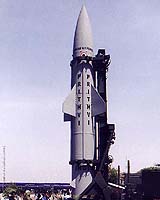
Bhubaneshwar, India (AFP) Jun 12, 2006 India on Sunday successfully tested a nuclear-capable missile fired from a mobile launcher in the eastern coastal state of Orissa, a defence ministry official said. The test of the Prithvi-1 (Earth) missile took place at the Chandipur-on-Sea test site, said the official, who declined to be named. The missile has a range of 250 kilometres (190 miles) and can carry conventional or low-yield nuclear warheads. Nuclear-capable India and Pakistan, who have fought three wars, routinely carry out missile tests and normally notify each other in advance under an agreement. The 8.5-metre (28-foot) surface-to-surface missile, first tested in February 1988, is under trials before its induction into the army's arsenal, other defence officials said. The missile was last tested last year. It is designed for battlefield use against troops or armoured formations. Two other variants of the Prithvi, with a strike range of between 250 and 350 kilometres, will be handed over to the navy and air force once tests are completed.
Source: Agence France-Presse Related Links Learn more about modern nuclear weapons doctrine  Trident 2s Targets
 Moscow (UPI) Jun 12, 2006
If you see a gun hanging on the wall at the beginning of a play, famous Russian writer Anton Chekhov used to say, you can be sure someone is going to get shot in the end. The United States seems to be doing just that, even with a risk of shooting itself in the foot. |
|
|

| The content herein, unless otherwise known to be public domain, are Copyright 1995-2006 - SpaceDaily.AFP and UPI Wire Stories are copyright Agence France-Presse and United Press International. ESA PortalReports are copyright European Space Agency. All NASA sourced material is public domain. Additionalcopyrights may apply in whole or part to other bona fide parties. Advertising does not imply endorsement,agreement or approval of any opinions, statements or information provided by SpaceDaily on any Web page published or hosted by SpaceDaily. Privacy Statement |