|
 |
 |
 |
 |
 |
 |
 |
 |
 |

| . |  |
. |
India To Launch More Lunar Missions Before 2015: Space Agency
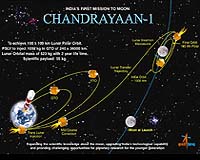
Udaipur, India (AFP) Nov 23, 2004 India will launch more missions to the moon if its maiden unmanned spacecraft Chandrayaan-1, slated to be launched by 2008, is successful in mapping the lunar surface, a top space official said Tuesday. "If there are good prospects for minerals then we will go for one or more robotic missions," said Madhavan Nair, chairman of the Indian Space Research Organisation (ISRO), the country's premier space agency. "It depends on the success of the first mission," said Nair, who was in the northern city of Udaipur to attend a five-day global conference on "Exploration and Utilization of the Moon." Nair said the two planned missions would be launched before 2015. India's 590 kilogram (1,298 pound) Chandrayaan-1, which will map the lunar terrain for minerals and conduct scientific experiments, will also carry an "impacter" module, Nair said. The "impacter" weighing 20 kilograms will descend from the lunar orbit and touch the moon's surface to examine the surface more closely, he said. "At the impact it will kick up some dust which our master control room will pick up through the mounted cameras and analyse. It is an one-shot affair," Nair explained. The European Space Agency and National Aeronautics and Space Administration's X-ray and laser equipment will ride piggyback on India's Chandrayaan-1. The ISRO chief called on the international community to draw a roadmap for future space programmes. "International cooperation and collaboration is needed rather than competition, which exists today, to share space on an equitable basis. All the five nations should join hands to minimise costs," Nair said. The United States, the European Space Agency, China, Japan and India are all planning lunar missions during the next decade. The conference being attended by more than 200 delegates from 16 countries will draft a declaration on Friday underlining future cooperation in space programmes. Related Links SpaceDaily Search SpaceDaily Subscribe To SpaceDaily Express  An "Ocean" Rendezvous On A Bone Dry Moon
 Washington DC (SPX) Nov 18, 2004
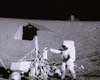
Thirty-five years ago this week, the sedentary, fine-grained powder located at 3.01239� S latitude, 23.42157� W longitude began to rise, billow and race off toward the horizon. Soon after - at 1:54:35 a.m. EST on Nov. 19, 1969 - the lunar module Intrepid landed, bringing two more humans to the surface of another world. |
|
|

| The content herein, unless otherwise known to be public domain, are Copyright 1995-2006 - SpaceDaily.AFP and UPI Wire Stories are copyright Agence France-Presse and United Press International. ESA PortalReports are copyright European Space Agency. All NASA sourced material is public domain. Additionalcopyrights may apply in whole or part to other bona fide parties. Advertising does not imply endorsement,agreement or approval of any opinions, statements or information provided by SpaceDaily on any Web page published or hosted by SpaceDaily. Privacy Statement |