|
 |
 |
 |
 |
 |
 |
 |
 |
 |

| . |  |
. |
India, U.S. Strategic Ties To Deepen No Matter Who Wins Whitehouse
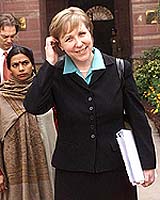
New Delhi (UPI) Oct 22, 2004 The United States has assured India that it would continue to work for closer strategic ties irrespective of the outcome of Nov. 2 presidential elections. Even as the United States is gripped in the final stages of the upcoming presidential polls, Washington continues to warm up to New Delhi in furthering strategic ties. Senior U.S. officials have been visiting India in recent weeks to further an alliance between the two sides. The two nations have agreed on a framework to advance cooperation in nuclear and strategic technology. U.S. Assistant Secretary of State for South Asian Affairs Christina Rocca was in New Delhi for a meeting with a group tasked with implementing the next step in strategic partnership. The NSSP, launched in January, is aimed at bolstering cooperation in civilian space and nuclear programs, high-technology commerce and dialogue on missile defense. Having come as far as we have our hope is that it will continue even if there is change of government, Rocca said in response to a question to the Nov. 2 U.S. presidential election results. Indian media reports quoted Indian and U.S. officials as saying that the NSSP would continue in the same direction and pace regardless of the outcome of the Bush-Kerry battle. The Times of India quoted Indian sources as saying that many Democrats have pledged to take high-tech cooperation with India even further than the Republicans. Rocca, who held bilateral talks on the implementation of the NSSP's first phase with S. Jaishankar of India's Foreign Ministry, said the two sides have agreed to set up a framework on the second phase and make it as rapid as possible. We have moved to a phase in Indo-U.S. relations where many barriers that separated us over ... many years have come down, she said. We are talking about a very important policy shift, which really moves this relationship on to strategic ground because we are talking about very sensitive things, Rocca said. The warming of Indo-U.S. strategic ties follows Washington's decision last month to lift sanctions on nuclear exports imposed on Indian organizations following India's 1998 nuclear tests. In September, Washington eased restrictions on the supply of equipment and technology for India's space and nuclear programs ahead of Prime Minister Manmohan Singh's summit with President George W. Bush in New York. Washington had also removed the Indian Space Research Organization from its list of organizations prohibited all technology transfer. Decisions will now be made on a case-by-case basis. The second phase of the NSSP would involve easing of export licensing policies to expand bilateral cooperation in commercial space programs. However, the United States is taking precautions by tightening export control laws to prevent any proliferation as it happened in Pakistan. To address Washington's concerns about proliferation, India has agreed to the United States positioning an export-control attache at the embassy in New Delhi to monitor end-use verification of the sensitive technology that the United States exports to India. United States now has placed five export-control attaches around the world in Abu Dhabi, Hong Kong, Moscow, Beijing and New Delhi. The two sides have not announced the next dates of NSSP dialogue, leaving it to the prerogative of the new regime in the White House. Despite warming ties, India remains committed to not signing the non-proliferation treaty, known as the NPT, or the Comprehensive Nuclear Test Ban Treaty, saying it is biased in favor of recognized nuclear powers. However, New Delhi has announced a self-moratorium and a no-first-use assurance. India and the United States have seen closer defense cooperation in the recent years. India has sided with Washington in its war on terror in Afghanistan, but New Delhi has avoided becoming embroiled in the war in Iraq. India shocked the world by conducting nuclear tests in 1998 that led to a series of international sanctions. India is destined to emerge as one of the leading nuclear-power technology countries in the world in the next two to four decades. In particular, it will be a leader in the technologies of pressurized heavy water reactors and fast breeder reactors, said M. R. Srinivasan, a former chairman of India's Atomic Energy Commission. The time has come for India, Russia, China and Pakistan to harmonize their nuclear security and energy development policies, while pursuing the ultimate objective of universal nuclear disarmament, Srinivasan said in an article published in The Hindu daily. Related Links SpaceDaily Search SpaceDaily Subscribe To SpaceDaily Express  Space Spuds To The Rescue
 Delavan WI (SPX) Oct 08, 2004
What could NASA, potatoes and China possibly have in common? The answer might be as close as your next order of fries. Using NASA technology and a Chinese technique for growing seed potatoes, Quantum Tubers are a Space Age answer to growing more and better potatoes worldwide. |
|
|

| The content herein, unless otherwise known to be public domain, are Copyright 1995-2006 - SpaceDaily.AFP and UPI Wire Stories are copyright Agence France-Presse and United Press International. ESA PortalReports are copyright European Space Agency. All NASA sourced material is public domain. Additionalcopyrights may apply in whole or part to other bona fide parties. Advertising does not imply endorsement,agreement or approval of any opinions, statements or information provided by SpaceDaily on any Web page published or hosted by SpaceDaily. Privacy Statement |