|
 |
 |
 |
 |
 |
 |
 |
 |
 |

| . |  |
. |
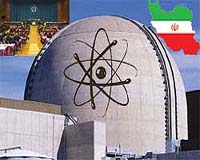
Iran May Suspend Enrichment
UPI Correspondent London (UPI) Sep 15, 2006 Iran has told the European Union it will consider suspending its uranium enrichment activities to allow for formal negotiations over its nuclear programs, the French government confirmed Friday. EU foreign policy chief Javier Solana said talks were "really making progress," but his assessment is at odds with that of the United States, which earlier dismissed the "alleged Iranian offer." "Iran... has accepted to talk about the question of suspension. That for us is a positive development," Government Spokesman Jean-Baptiste Mattei told a Paris news briefing. "Like you, I see that there are a number of rumblings which are interesting, notably the fact that Iran has apparently accepted to discuss the question of suspension," he added. The developments were announced following a Vienna meeting between Solana and Iran's chief nuclear negotiator Ali Larijani last weekend. Speaking to journalists after briefing EU foreign ministers in Brussels Friday, Solana said: "I think I can say honestly that we're making progress. It doesn't mean that everything has been solved. That would be an exaggeration, but we are really making progress." His officials and Iranian officials were meeting every day to try and resolve outstanding issues, he added. Earlier, German Foreign Minister Frank Walter Steinmeier told reporters at the meeting that the Solana-Larijani talks had apparently started Iran on "a process of intensive political thinking" which could result in new moves from Tehran. Iran failed to comply with an Aug. 31 U.N. Security Council deadline to suspend its enrichment program, a precondition set by France, Britain, Germany, Russia, the United States and China for negotiations on a package of economic and other incentives aimed at persuading the Islamic Republic to abandon its production of nuclear fuel. Tehran insists its nuclear programs are for peaceful energy purposes only, but the United States and some other Western nations have accused it of trying to develop a nuclear weapon. It is understood that a two-month suspension is being discussed, but that Iran is reluctant to implement it before the commencement of talks. However Solana indicated that such reticence could be overcome. "We will not start negotiating formally with activity on enrichment. That is understood by the Iranians," he said. Solana's optimism contrasts with the skepticism of the United States, which fears Iran is simply stalling in order to ward off Security Council sanctions. U.S. State Department Deputy Spokesman Tom Casey Tuesday brushed aside reports of "some alleged Iranian offer." "There's been no change in the Iranian position, meaning they have not agreed to suspend uranium enrichment activities for any length of time that I'm aware of," he said. The sharply differing approaches to the dispute were also evident at a meeting of the 35-nation board of the International Atomic Energy Agency in Vienna Tuesday. Diplomats from the six-nation alliance abandoned attempts to issue a united condemnation of Iran's stance after failing to agree on language -- China and Russia reportedly refused to back the tough rhetoric advocated by the United States, while Germany is also understood to have harbored reservations. The depth of the split was reflected in the separate statements delivered by the United States and Europe. While the latter urged Iran to come to the table, Washington insisted it was time to punish the Islamic Republic with sanctions. "We continue to extend an open hand to Iran," the European statement said. If Iran agreed to temporarily halt enrichment, it added, "we will ask to suspend action in the Security Council." The three nations said that the meetings between Solana and Larijani had "helped clarify some misunderstandings." "We support these ongoing efforts aimed at convincing Iran to comply with its international obligations, while paving the way for a diplomatic solution," the statement said But the U.S. chief delegate to the IAEA, Gregory L. Schulte, accused Iran of "a history of deception, lack of transparency, provocative behavior and disregard for its international obligations." "The time has come for the Security Council to back international diplomacy with international sanctions," he insisted. Referring to Iran's reported willingness to consider a suspension, Schulte continued: "We are interested in more than words. We are interested in action." The United States intends to push for sanctions at a special session of the U.N. General Assembly in New York next week. But China and Russia, both Security Council veto-holders with interests in Iran's oil and nuclear industries respectively, have insisted repeatedly they will not endorse such a move. Meanwhile European nations are reluctant to commit to any course of action that could ultimately lead to the use of force, which would be impossible to sell politically. In the wake of the Iraqi WMD affair, Europeans are deeply skeptical of the motives and trustworthiness of the U.S. administration in matters of foreign affairs. Such suspicions have only been compounded by the IAEA's condemnation this week of a U.S. report on Iran as "outrageous and dishonest." Even if Iran agrees to suspend enrichment, questions nevertheless remain as to whether the six nation alliance can agree on an incentive package that Tehran would find acceptable. Iran has requested assurances on its security, which the United States has so far resisted. Therefore, though Iran may be close to meeting the enrichment demand, the cracks in the six nation alliance mean a resolution to the dispute is as distant as ever.
Source: United Press International Related Links Learn about nuclear weapons doctrine and defense at SpaceWar.com Learn about missile defense at SpaceWar.com  The Great Korean Divide
 Washington (UPI) Sep 15, 2006
Words of fraternity and renewed common cause were sounded at the White House Thursday by President George W. Bush and South Korean President Roh Moo-hyun, but behind public amity the fact remains: relations between Washington and Seoul are stressed and are unlikely to improve in the foreseeable future. |
|
|

| The content herein, unless otherwise known to be public domain, are Copyright 1995-2006 - SpaceDaily.AFP and UPI Wire Stories are copyright Agence France-Presse and United Press International. ESA PortalReports are copyright European Space Agency. All NASA sourced material is public domain. Additionalcopyrights may apply in whole or part to other bona fide parties. Advertising does not imply endorsement,agreement or approval of any opinions, statements or information provided by SpaceDaily on any Web page published or hosted by SpaceDaily. Privacy Statement |