|
 |
 |
 |
 |
 |
 |
 |
 |
 |

| . |  |
. |
James Webb Telescope Sunshield Membrane Passes Tests
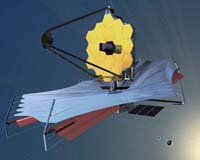
Redondo Beach CA (SPX) May 15, 2006 Northrop Grumman announced Monday its engineering team has successfully completed a series of tests on a key element of the James Webb Space Telescope. Engineers tested the JWST�s sunshield membrane, a five-layer structure about the size of a tennis court. The sunshield will block solar light and keep the observatory operating at the cryogenic temperatures necessary for its infrared sensors to see distant galaxies, early stars, exoplanets systems and perhaps detect the mysterious dark matter that constitutes about one-quarter of the universe. Passing the tests demonstrated that the membrane has achieved Technology Readiness Level 6, a measure used by the U.S. government to assess the maturity of evolving technologies. A level 6 rating means a system has been tested successfully in a relevant operational environment. Engineering development and testing will continue for the next three years, but the current testing milestone concludes all basic technology development required for the sunshield, Northrop Grumman said in a statement. The company performed a series of 26 tests of the membrane at facilities across the country, starting in 1999 and concluding late last year. The tests, which measured the performance of the membrane and its coatings, simulated conditions at the L2 Lagrange point nearly 1 million miles from Earth, where JWST will operate. Each sunshield membrane layer is about as thick as a human hair (one to two-thousandths of an inch thick) and is made of a polymer-based film, DuPont Kapton E. Fabrication of the sunshield membranes is being performed by SRS Technologies, of Newport Beach, Calif., at its facility in Huntsville, Ala., and integrated with the sunshield at Northrop Grumman's Space Park facility in Redondo Beach. The layers are separated from each other and held in place by deployable booms. During JWST's five to 10 year mission, the membrane will be subject to bombardment from micro-meteoroids similar to very fine sand particles and several different types of radiation. It will have to resist abrasion, tension, tearing and cracking, all at extreme temperatures that range from 400 degrees Kelvin (260 degrees Fahrenheit) to 30 degrees K (-406 degrees F). A significant challenge was locating, modifying, or in some cases, creating equipment or testing methods that would accurately measure the exacting performance standards set for the membrane. Because no existing equipment was able to apply very low-energy proton radiation bombardment, Northrop Grumman worked with scientists at the University of Dayton Research Institute at Wright-Patterson Air Force Base, Ohio, to modify a low-energy proton gun used for tests. Micro-meteoroid impact tests were conducted at Auburn University's Hypervelocity Impact Facility in Auburn, Ala. To run samples at cryogenic temperatures, engineers modified existing equipment and added a cryogenic cooler, which was donated by Marshall Space Flight Center in Huntsville. There were also manufacturing and materials challenges in applying the silicon coating to the membrane. Northrop Grumman engineers worked closely with the thin-film coating supplier, Sheldahl Inc., of Northfield, Minn., to make the silicon conductive and modify the coating process to ensure consistency when the silicon is deposited on membrane sheets using a continuous-roll coating process. Northrop Grumman is prime contractor for JWST and leads the telescope's overall system design and development effort under contract to NASA's Goddard Space Flight Center. Related Links JWST Northrop Grumman  Astronomers Create Biggest Sky Map Yet
 Princeton NJ (SPX) May 15, 2006
Astronomers said Monday they have created a map of the sky containing structures more than 1 billion light-years across. The team built a three-dimensional portrait of the structures by observing more than 600,000 galaxies using Sloan Digital Sky Survey data, which covers over one-tenth of the sky. |
|
|

| The content herein, unless otherwise known to be public domain, are Copyright 1995-2006 - SpaceDaily.AFP and UPI Wire Stories are copyright Agence France-Presse and United Press International. ESA PortalReports are copyright European Space Agency. All NASA sourced material is public domain. Additionalcopyrights may apply in whole or part to other bona fide parties. Advertising does not imply endorsement,agreement or approval of any opinions, statements or information provided by SpaceDaily on any Web page published or hosted by SpaceDaily. Privacy Statement |