|
 |
 |
 |
 |
 |
 |
 |
 |
 |

| . |  |
. |
Lack of troops, strategy hampering Afghan campaign: think-tank
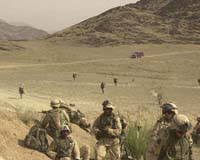
London (AFP) Oct 16, 2007 A lack of strategy plus troop shortages are hampering NATO's effort to beat the Taliban and Al-Qaeda in Afghanistan, a leading British foreign affairs think-tank said Tuesday. Chatham House researchers said it was generally accepted that the 39,000-strong International Security Assistance Force (ISAF) had suffered from a lack of troops since the 2003 invasion of Iraq. But they said there was a "more fundamental difficulty" -- the failure to develop a "coherent approach" on how to achieve NATO and coalition objectives in Afghanistan. In a strongly-worded briefing paper, Timo Noetzel, from Chatham House's international security team, and Sibylle Scheipers, who studies the changing character of war at Oxford University, said NATO was failing on three levels. Instead of a comprehensive strategy, NATO had devised "partial and ad-hoc solutions" to eliminating Al-Qaeda, defeating the Taliban and helping Afghanistan become a more stable and democratic state. Early gains were unsustainable, with the knock-on effect being Taliban fighters regrouping and filling the security vacuum, which is likely to continue as long as insurgents find a safe haven in Pakistan. Operationally, caveats on NATO members with forces in Afghanistan were affecting efforts to counter long-term insurgency, particularly in the volatile south, where most of Britain's 7,000-strong contingent is based. The report said individual countries' restrictions on their troops engaging in combat operations in the south for fear of troop casualties made the chances of success more unpredictable. "This is testing the coalition's internal cohesion, which is becoming increasingly fragile," they said. "The willingness to share risks has become a key issue. Not all NATO member states are prepared to send their forces into combat. This puts the fundamental principle of alliance solidarity on the line," it said. Tactically, a shortage of troops has made even stability and reconstruction operations difficult, they assessed. "Alliance and coalition forces are short of relevant capabilities... Resources to provide for operational mobility remain scarce," they added. "The sheer lack of manpower is a growing problem. Western and Afghan forces are too thinly stretched across Afghanistan," they added, with the problem more acute in the south. The shortfall means coalition forces cannot hold areas seized from the Taliban for long, increasing the reliance on air power that risks increasing civilian casualties, which in turn undermines NATO's legitimacy among locals. Community Email This Article Comment On This Article Related Links News From Across The Stans
 British colonel hails turnaround on Taliban
 London (AFP) Oct 13, 2007
A British battalion achieved an "astonishing" turnaround in the fight against the Taliban, their commanding officer said Saturday ahead of their return from Afghanistan. |
|
|

| The content herein, unless otherwise known to be public domain, are Copyright 1995-2007 - SpaceDaily.AFP and UPI Wire Stories are copyright Agence France-Presse and United Press International. ESA Portal Reports are copyright European Space Agency. All NASA sourced material is public domain. Additional copyrights may apply in whole or part to other bona fide parties. Advertising does not imply endorsement,agreement or approval of any opinions, statements or information provided by SpaceDaily on any Web page published or hosted by SpaceDaily. Privacy Statement |