|
 |
 |
 |
 |
 |
 |
 |
 |
 |

| . |  |
. |
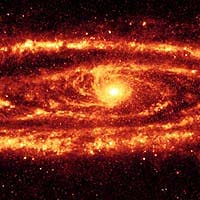
Lady In Red: Andromeda Galaxy Shines In Spitzer's Eyes
Harvard MA (SPX) Oct 14, 2005 NASA's Spitzer Space Telescope has captured a stunning infrared view of Messier 31, the famous spiral galaxy also known as Andromeda. Andromeda is the most-studied galaxy outside our own Milky Way, yet Spitzer's sensitive infrared eyes have detected captivating new features, including bright, aging stars and a spiral arc in the center of the galaxy. The infrared image also reveals an off-centered ring of star formation and a hole in the galaxy's spiral disk of arms. These asymmetrical features may have been caused by interactions with the several satellite galaxies that surround Andromeda. "Occasionally small satellite galaxies run straight through bigger galaxies," said Dr. Karl Gordon of the Steward Observatory, University of Arizona, Tucson, lead investigator of the new observation. "It appears a little galaxy punched a hole through Andromeda's disk, much like a pebble breaks the surface of a pond." Approximately 2.5 million light-years away, Andromeda is the closest spiral galaxy and is the only one visible to the naked eye. Unlike our Milky Way galaxy, which we view from the inside, Andromeda is studied from the outside. Astronomers believe that Andromeda and the Milky Way will eventually merge together. Spitzer detects dust heated by stars in the galaxy. Its multiband imaging photometer's 24-micron detector recorded approximately 11,000 separate infrared snapshots over 18 hours to create the new comprehensive mosaic. This instrument's resolution and sensitivity is a vast improvement over previous infrared technologies, enabling scientists to trace the spiral structures within Andromeda to an unprecedented level of detail. "In contrast to the smooth appearance of Andromeda at optical wavelengths, the Spitzer image reveals a well-defined nuclear bulge and a system of spiral arms," said Dr. Susan Stolovy, a co-investigator from the Spitzer Science Center at the California Institute of Technology, Pasadena. The galaxy's central bulge glows in the light emitted by warm dust from old, giant stars. Just outside the bulge, a system of inner spiral arms can be seen, and outside this, a well-known prominent ring of star formation. Related Links SpaceDaily Search SpaceDaily Subscribe To SpaceDaily Express  HETE-2 Satellite Solves Mystery Of Cosmic Explosions
 Washington DC (SPX) Oct 06, 2005
An international team of scientists using three NASA satellites and a host of ground-based telescopes believes it has solved the greatest remaining mystery of the mysterious gamma-ray bursts (GRBs), the most powerful explosions in the universe.
--------------------------------------------------------- It's new. And it's downright terrific! Celestron's CPC Schmidt-Cassegrain telescope is the scope you've been waiting for! It offers new alignment technology, advanced engineering, and bold new design at a new, low price! In fact, Celestron's Professional Computerized (CPC) scope with revolutionary SkyAlign Alignment Technology redefines everything that amateur astronomers are looking for. It offers quick and simple alignment, GPS technology, unsurpassed optical quality, ease of use, advanced ergonomics, enhanced computerization and, most important, affordability. Want to view M-31 tonight? One button takes you there!
Shop for telescopes online at Telescopes.com! today!
|
|
|

| The content herein, unless otherwise known to be public domain, are Copyright 1995-2006 - SpaceDaily.AFP and UPI Wire Stories are copyright Agence France-Presse and United Press International. ESA PortalReports are copyright European Space Agency. All NASA sourced material is public domain. Additionalcopyrights may apply in whole or part to other bona fide parties. Advertising does not imply endorsement,agreement or approval of any opinions, statements or information provided by SpaceDaily on any Web page published or hosted by SpaceDaily. Privacy Statement |