|
 |
 |
 |
 |
 |
 |
 |
 |
 |

| . |  |
. |
Last of NASA's Great Observatories Set For Launch
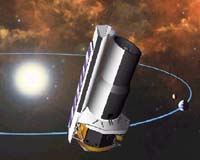
Florida - Aug 11, 2003 Launch of NASA's Space Infrared Telescope Facility is progressing towards an August 23, 2003 launch date with a window at 1:37:29am EDT. Final observatory closeouts were completed on Aug. 3 with mating to the payload attach fitting beginning last Tuesday. Transportation to Pad 17-B is currently scheduled for Aug. 10. Cryogenic servicing of the observatory with liquid helium was performed on July 22. The erection of the Boeing Delta II launch vehicle on Pad 17-B began on Friday, July 18, with the erection of the first stage. Erection of the nine solid rocket boosters began on Saturday, July 19 and was completed on Friday, July 25. The second stage was hoisted atop the first stage on July 28. The fairing was hoisted into the launch pad clean room area on July 29. The Flight Program Verification, an integrated test of the vehicle and the spacecraft, is scheduled to occur Aug. 12. The payload fairing will be installed around SIRTF atop the Delta II on Aug. 14, followed by servicing with cryogenic helium. SIRTF is the fourth and final element in NASA's family of orbiting "Great Observatories." All objects in the universe with temperatures above absolute zero (-460 F) emit some infrared radiation, or heat. Infrared wavelengths lie beyond the red portion of the visible spectrum and are invisible to the human eye. Most infrared light emitted by celestial objects is absorbed by Earth's atmosphere. Scientists rely on orbiting telescopes such as SIRTF to capture data on celestial objects and phenomena that are too dim, distant or cool to study using ground-based telescopes or by other astronomical techniques. Related Links Space Infrared Telescope Facility SpaceDaily Search SpaceDaily Subscribe To SpaceDaily Express  World's Largest Robotic Telescope Ready For Action
 Swindon - Aug 11, 2003
The Liverpool Telescope, the world's largest fully robotic telescope, has snapped its first images of the heavens this week. This 2 meter optical telescope is owned by the Astrophysics Research Institute (ARI) of Liverpool John Moores University (JMU), but observes autonomously from its site on La Palma in the Canary Islands. The telescope was designed, constructed and commissioned by Telescope Technologies Ltd., a subsidiary company of JMU.
--------------------------------------------------------- It's new. And it's downright terrific! Celestron's CPC Schmidt-Cassegrain telescope is the scope you've been waiting for! It offers new alignment technology, advanced engineering, and bold new design at a new, low price! In fact, Celestron's Professional Computerized (CPC) scope with revolutionary SkyAlign Alignment Technology redefines everything that amateur astronomers are looking for. It offers quick and simple alignment, GPS technology, unsurpassed optical quality, ease of use, advanced ergonomics, enhanced computerization and, most important, affordability. Want to view M-31 tonight? One button takes you there!
Shop for telescopes online at Telescopes.com! today!
|
|
|

| The content herein, unless otherwise known to be public domain, are Copyright 1995-2006 - SpaceDaily.AFP and UPI Wire Stories are copyright Agence France-Presse and United Press International. ESA PortalReports are copyright European Space Agency. All NASA sourced material is public domain. Additionalcopyrights may apply in whole or part to other bona fide parties. Advertising does not imply endorsement,agreement or approval of any opinions, statements or information provided by SpaceDaily on any Web page published or hosted by SpaceDaily. Privacy Statement |