|
 |
 |
 |
 |
 |
 |
 |
 |
 |

| . |  |
. |
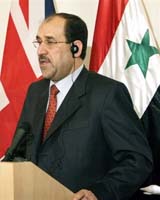
Maliki Calls On US To Better Arm Iraqi Army
London (AFP) Jan 17, 2007 The United States can "dramatically" cut its troop presence in Iraq within three to six months if it released the necessary weapons to the war-torn country's army, Iraqi Prime Minister Nuri al-Maliki said in an interview published in an early edition of The Times on Thursday. Maliki said that the violent insurgency in Iraq was bloodier and longer than it should have been because the United States refused to part with arms, and also rejected claims that his government was on "borrowed time" as US Secretary of State Condoleezza Rice has said. "If we succeed in implementing the agreement between us to speed up the equipping and providing weapons to our military forces, I think that within three to six months our need for American troops will dramatically go down," Maliki was quoted as saying by The Times. "That is on condition that there are real, strong efforts to support our military forces and equipping and arming them." The United States has held back from supplying the Iraqi Army with large quantities of weapons because they have sometimes ended up with militia forces and even insurgents. Speaking to The Times, White House national security spokesman Gordon Johndroe admitted that some of the Iraqi prime minister's criticisms were "valid". By "self-admission we have had to re-do our training and equipment programme," he said. Maliki also fired back at Rice's testimony to a congressional panel on January 11, saying that his government is "in a sense, on borrowed time". "Certain officials are going through a crisis. Secretary Rice is expressing her own point of view if she thinks that the government is on borrowed time, whether it is borrowed time for the Iraqi government or the American administration," he told The Times. "I don't think we are on borrowed time." The prime minister added that he believed such messages from US government officials gave strength to terrorists within Iraq, commenting: "I wish that we could receive strong messages of support from the US so we don't give some boost to the terrorists and make them feel that they might have achieved success." "I believe that such statements give moral boosts to the terrorists and push them towards making an extra effort and making them believe that they have defeated the American administration, but I can tell you that they haven't defeated the Iraqi government." Maliki and his government have at times had tense relations with the United States, evidenced by his lukewarm endorsement for President George W. Bush's plan to rescue Iraq from chaos, delivered three days after the new policy was unveiled. The prime minister also conceded in the interview that his government has made "mistakes" in relation to the execution of former Iraqi dictator Saddam Hussein, but refused to accept all of the blame. He also dismissed accusations that the government was being lenient with Shiite militias, telling The Times that 400 members of the Mahdi Army had been arrested in recent days.
Source: Agence France-Presse Related Links Iraq: The first technology war of the 21st century  Looking Ahead In Iraq
 Washington (UPI) Jan 17, 2007
Getting the political situation right in Iraq can only work if security improves. While this may seem like a Sisyphean task with the full support of the international community, particularly America's NATO allies, the United States might be able to stabilize the situation. Turning Iraq into a NATO operation would not be easy nor would it be a panacea, but it could provide enough breathing room to get things back on track. |
|
|

| The content herein, unless otherwise known to be public domain, are Copyright 1995-2006 - SpaceDaily.AFP and UPI Wire Stories are copyright Agence France-Presse and United Press International. ESA PortalReports are copyright European Space Agency. All NASA sourced material is public domain. Additionalcopyrights may apply in whole or part to other bona fide parties. Advertising does not imply endorsement,agreement or approval of any opinions, statements or information provided by SpaceDaily on any Web page published or hosted by SpaceDaily. Privacy Statement |